A single-sided flag is printed from one face, so the back shows a lighter mirror image; a double-sided flag carries its own print on each face.
- Single-sided (single-reverse): one layer printed from one face; lightest and cheapest; text reads backwards from behind.
- One layer printed on both faces: strong color on both sides; it can carry a second design, but the other side can show through.
- Three-layer double-sided: two printed layers with a blockout layer between them; each face reads correctly, with the cleanest result.
- Wind: the three-layer flag is heavier and needs more wind to fly.
- At Senior Flags: samples take 5-7 calendar days from artwork confirmation; the MOQ applies per design.
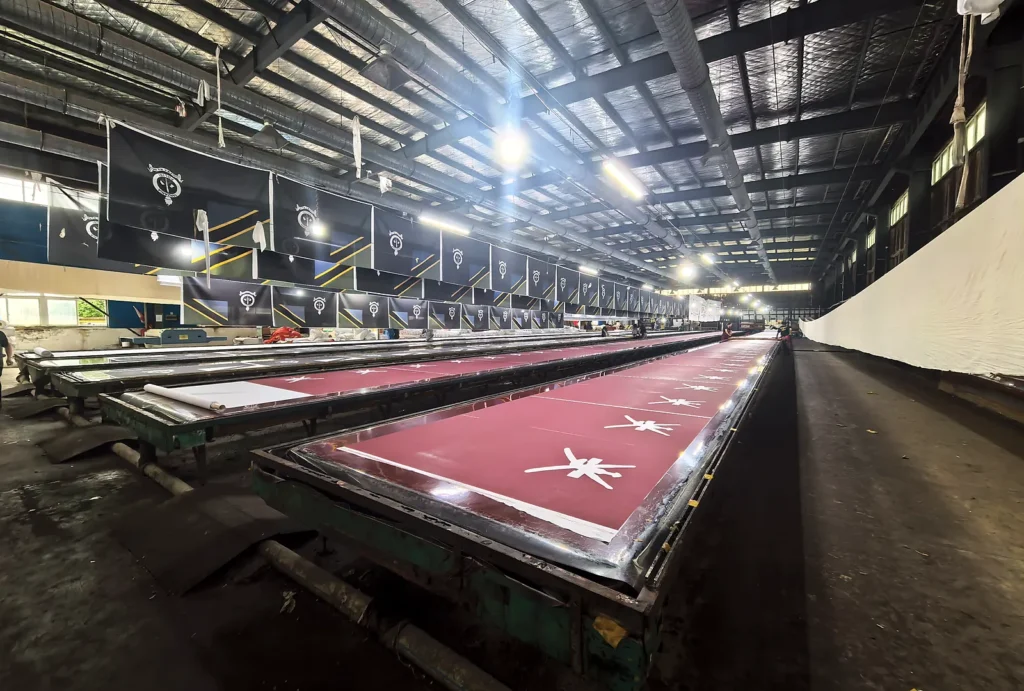
From our factory
Senior Flags has made flags in Lu’an, Anhui, since 2003, in all three constructions: single-sided, one layer printed on both faces, and three-layer, with an interlayer between two printed layers. Both double-sided versions can carry a different design on each face; the interlayer version gives the cleaner result.
What does the back of a single-sided flag look like?
The back of a single-sided flag shows the same design as a mirror image, slightly lighter, because the ink passes through the fabric. People who receive their first printed flag often ask whether the back is meant to look like that. Usually it is: the flag was printed from one side only, and the ink passed through to the other. On a single-sided flag the printer only prints one face. How much shows on the back depends mostly on the fabric:
- Knitted polyester (110 gsm) has an open structure, so ink strikes through well. The back is readable but mirrored and a little lighter. This is why single-sided works for many feather and teardrop flags.
- 68D polyester is the lightest fabric base we use. Show-through is clear, which suits hand flags and car window flags.
- Woven 100D and 300D polyester are denser. Less ink reaches the back, so the reverse looks paler.
- Felt and PVC are different again. Print does not strike through them the way it does through thin polyester, so ask for a double-sided quote if the back will be seen.
None of this is a defect if you ordered single-sided. It becomes a problem when the buyer expected two readable faces and nobody said so before the order.
What are the three ways to make a flag, and how do their backs differ?
Flags are made in three constructions: single-sided, one layer printed on both faces, and three-layer double-sided with a blockout layer. “Double-sided” is used for two different products, and the difference shows on the back of the flag:
- Single-sided. One layer, printed from one face. The back is a lighter mirror image.
- One layer, printed on both faces. The same layer is printed from each side, so both faces have strong color. Printed with one design, the back is a mirror image. Each face can also carry its own design, but with no blockout layer the other side can show through.
- Three-layer double-sided. Two printed layers with an opaque blockout layer sewn between them. Each face reads correctly, and the two faces can carry different designs.
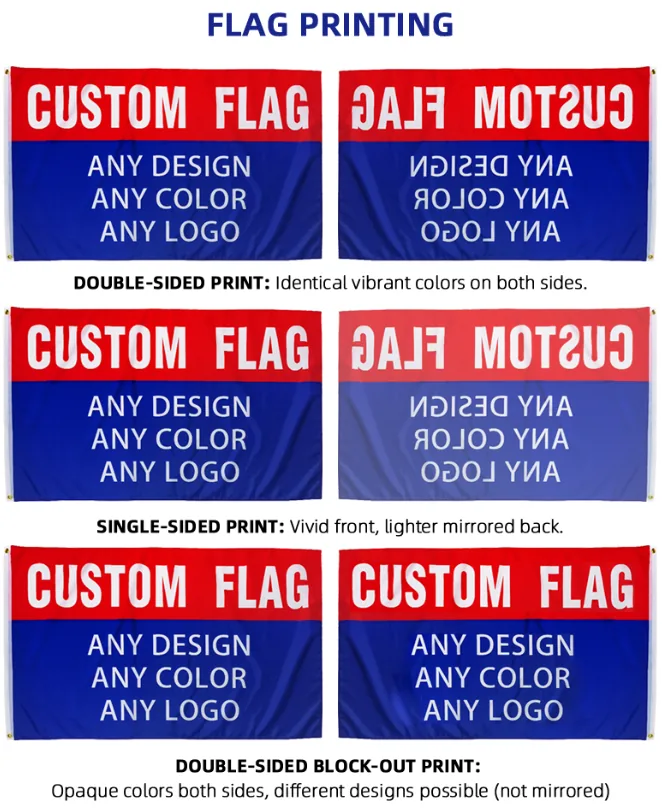
If a quote just says “double-sided”, ask which of the last two it means. They differ in price, in weight and in how text reads from behind.
What is the difference between single-sided and double-sided flags?
Single-sided flags are lighter, cheaper and fly more easily; double-sided flags read correctly from both sides but weigh and cost more.
| Single-sided (single-reverse) | One layer, printed on both faces | Three-layer double-sided | |
|---|---|---|---|
| Construction | 1 layer, printed from one face | 1 layer, printed from each face | 2 printed layers plus a blockout layer |
| Back of the flag | Mirror image, lighter | Mirror image, same strong color | Its own print, reads correctly |
| Text and logos seen from behind | Backwards | Backwards, unless the back is printed as its own design | Correct |
| Two different designs | Not possible | Possible, but the other side can show through | Possible, with the cleanest result |
| Weight | Lightest | About the same as single-sided | Roughly double the fabric, plus the blockout |
| Movement in light wind | Flies easily | Flies easily | Needs more wind, hangs heavier |
| Price | Base price | Higher: a second print pass | Highest: two printed layers, blockout and extra sewing |
| Sampling at Senior Flags (from artwork confirmation, excl. shipping) | 5-7 calendar days | 5-7 calendar days | 5-7 calendar days |
| Bulk production (from artwork confirmation, excl. shipping) | 15-20 calendar days | 15-20 calendar days | 15-20 calendar days |
How the three constructions compare in Senior Flags production. Weight and price are relative, not measured figures; times are calendar days from artwork confirmation, excluding shipping.
When should you choose a single-sided flag?
Choose a single-sided flag when it has to move in light wind, when it is seen mostly from one side, or when the design has no text.
- Advertising flags on poles. Feather and teardrop flags are printed on 110 gsm knitted polyester so they catch light wind. Single-sided is the cheaper option, and the readable reverse is good enough for images and logos. When wording must read correctly from both directions, both are available double-sided. Our double-sided teardrop flag is two layers of 110 gsm knitted polyester with an interlayer, so expect it to need more wind to open. Compare the two shapes in feather vs teardrop flags.
- Hand flags and car window flags. These are waved or driven past. Nobody studies the reverse, and the light 68D base keeps cost down on 100-piece orders. Car flags can also be ordered double-sided. If a slogan must read correctly from both directions, ask whether the double-sided version is built from two printed layers, because one layer printed on both faces still reads backwards from behind.
- Designs without lettering. A symmetric logo, a pattern or most national flags look acceptable mirrored.
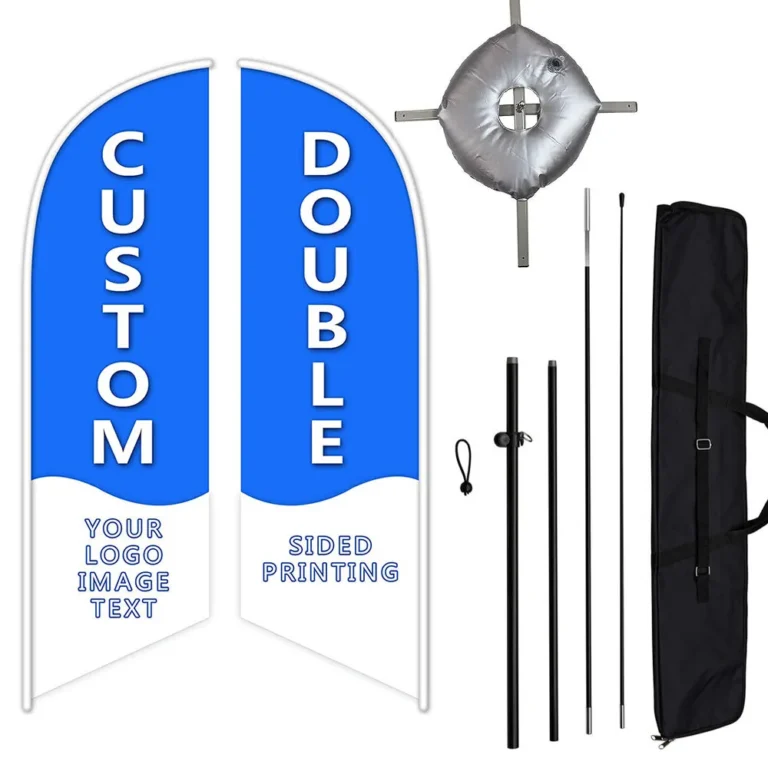
 Double-sided option: two layers with an interlayerCustom Teardrop FlagsSenior Flags makes custom teardrop flags in 110gsm knitted polyester (other fabrics on request), in five sizes from 166 × 75 cm to 350 × 130…View specifications →
When is a double-sided flag worth the extra cost?
A double-sided flag is worth the extra cost when people will read it from both directions, especially when it carries text.
- Text, phone numbers or a wordmark. On a single-sided flag they read backwards from behind. A one-layer flag can carry correctly reading text on the back if the back is printed as its own design, but the front can show through. A three-layer flag with a blockout layer gives the cleanest result.
- Flags hung across a space. Bunting strung across a street or hall is seen from both sides. Our bunting can be printed on one side or both, and double-sided is the option for crossings. If the pennants carry lettering, ask how the double-sided version reads from behind. See custom bunting, and for fixings and spans, how to hang bunting outside.
- Garden flags. People see them from the house and from the street. Ours are double-layer 300D polyester printed on both sides, with single-sided printing available on request. See garden flags.
- Club exchange pennants. Satin exchange pennants can be made in two layers with an inter-layer so both faces carry the crest. See pennant flags.
Expect the three-layer version to hang more heavily. Flag supplier Flags International notes that a double-sided flag is “made of 3 pieces of material”, is “much heavier than a ‘single-reverse’ flag” and “takes more wind to fly”. If the flag goes on a pole in a sheltered spot, check that it will still open out in the wind it actually gets. For washing and drying a heavier flag, see our flag care guide.
Not sure which construction your design needs? Send us the artwork and tell us where the flag will hang. We reply with the construction we recommend, the sample time and a quotation for each option.
What should you tell a flag factory about printed sides?
Tell the factory the construction, the artwork for each side and whether lettering must read from behind, all in the first email. Put these lines in your request for quotation:
- Construction. Write “single-sided”, “one layer printed on both sides” or “three-layer double-sided with blockout”. Do not leave it to the default, and do not write only “double-sided”.
- Artwork for each side. Same design on both faces, or two different designs? Send one file per side for a three-layer flag.
- Text direction. If the design has lettering that must read from behind, order a three-layer flag, or a one-layer flag with the back printed as its own design and some show-through accepted. Otherwise, confirm you accept the mirrored reverse.
- Blockout layer. For a three-layer flag, ask what the blockout layer is made of and check it on the sample.
- Fabric and size. The fabric changes how much shows through on single-sided flags. Our flag fabric guide compares the options, and standard sizes are in our flag size chart.
- A physical sample. Check the sample, front and back, before bulk. Our production time is counted from artwork confirmation, so ask how approving a sample first changes the bulk date. More on timing in custom flag MOQ and lead times.
How can you check that a flag is really three-layer double-sided?
A three-layer flag blocks light through the printed area, shows two printed layers at the hem and weighs roughly twice a single-sided flag. Three quick checks confirm what arrived:
- Hold it up to a window. With a blockout layer, little or no light passes through the printed area. A single layer glows.
- Look at the edge. The hem should catch two printed layers with the blockout layer between them.
- Weigh it against a single-sided flag of the same size and fabric. With two printed layers plus the blockout, it should weigh roughly twice as much or more.
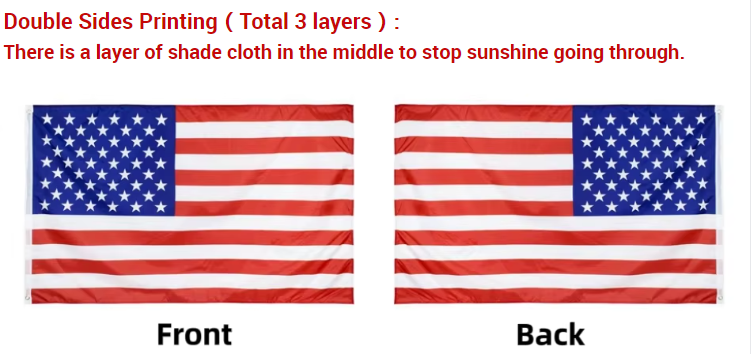
A one-layer flag printed on both faces passes none of these checks, and that is fine if it is what you ordered. It is a lighter, cheaper construction, not a fake. Problems start when the quote and the delivery describe different things.
Which flags are usually single-sided or double-sided?
Advertising, hand and car flags are usually single-sided; garden flags and bunting hung across a space are usually double-sided.
| Product | Usual choice | Why |
|---|---|---|
| Feather and teardrop flags | Single-sided; three-layer available | Light knitted fabric has to fly; the reverse is readable |
| National flags | Single-sided; double-sided on request | Most national designs read acceptably mirrored. Exceptions include flags with lettering and Paraguay, whose two faces carry different seals |
| Hand flags | Single-sided | Waved, seen briefly, cost-sensitive |
| Car window flags | Single-sided; double-sided available | Seen while moving |
| Garden flags | Double-sided, double-layer 300D | Seen from the house and the street |
| Bunting across a street or hall | Double-sided | Read from both directions |
| Satin exchange pennants | Two layers with an inter-layer | Crest on both faces |
Usual choices in Senior Flags orders. If your design needs the other construction, ask for both on the same quotation.
Frequently asked questions
Are flags double-sided?
Most printed flags are not. They are single-sided, printed through so the back shows a mirror image. Double-sided flags are a separate order option, built either as one layer printed on both faces or as three layers with a blockout, and you have to ask for them.
What is a single reverse flag?
The flag trade’s name for a single-sided flag. It reads correctly on the front and shows a mirror image on the back.
What is a two-sided flag?
A flag whose two faces carry different designs, or a design that must read correctly on both faces. Paraguay’s national flag shows the national seal on the front and the treasury seal on the back, and Oregon is the only US state flag with a different design on each side: a beaver on the reverse. Both need the three-layer construction.
Why is the writing backwards on the back of my flag?
Because the flag is single-sided, or one layer printed on both faces with one design. In both cases the back is a mirror image of the front. To read correctly from both sides, the back needs its own print: a three-layer flag with a blockout layer gives the cleanest result.
What is a blockout layer on a flag?
An opaque layer sewn between the two printed layers of a three-layer flag. It stops light and print showing through, so each face can carry its own design.
Do double-sided flags cost more?
Yes. A one-layer flag printed on both faces needs a second print pass. A three-layer flag also adds a second printed layer, the blockout and extra sewing, so it costs and weighs the most. Ask for single-sided and double-sided prices on the same quotation, and name the construction you want priced.
Will a double-sided flag fly in light wind?
A three-layer flag needs more wind than a single-sided flag of the same size because it is heavier. For pole-mounted advertising flags in low-wind locations, single-sided usually works better.
How long does a double-sided sample take?
At Senior Flags, a sample takes 5-7 calendar days and bulk production 15-20 calendar days, both counted from artwork confirmation and excluding shipping.
Not sure which construction fits your order? Request a sample of both. Samples take 5-7 calendar days from artwork confirmation, excluding shipping. Sample fees are quoted per product: a national flag sample, for example, is USD 80 excluding freight and can be credited against the bulk order. The MOQ for most custom flags starts at 100 pcs (10 pcs for feather and teardrop flags, or 10 sets with poles). Request a sample
Sample time, sample fee and minimum order quantities were confirmed by Senior Flags in October 2026 and are confirmed again per order on the quotation. The examples of flags with a different design on each side (Paraguay and Oregon) and the construction terms come from the sources linked in the text, read in October 2026.