A flag’s aspect ratio is its height (hoist) to its length (fly); among national flags, 2:3 and 1:2 are the most common.
- Next most common: 3:5
- Extremes: Nepal’s non-rectangular flag (about 1.22:1), the square flags of Switzerland and Vatican City, and Qatar’s 11:28
- Set by each country: Germany 3:5, China and Japan 2:3, the United States 10:19 for most federal sizes
- Matched sets: the US Flag Code, 4 U.S.C. § 7(g), asks for about equal size, so order one hoist height or one area for all, with each flag in its own ratio
Ratios are written height first in this guide, as in Wikipedia’s list and the German and Japanese texts; China’s specification gives the length first (3:2), which is the same shape as 2:3.
What are the most common national flag ratios?
2:3 is the most common national flag ratio, with roughly 85 flags, followed by 1:2 with 50–60.
Wikipedia’s list of national flags of sovereign states gives a ratio for every sovereign state. Counting it in October 2026 puts 2:3 first with roughly 85 flags, 1:2 second with between 50 and 60, and 3:5 third with about 20; about 20 more flags use other ratios. The exact counts depend on how states with more than one flag are counted, and they change as flags are revised.
| Ratio | Flags with this ratio (approx.) | Examples | Our standard national flag size at this ratio |
|---|---|---|---|
| 2:3 | about 85 | China, Russia, France, Italy, Spain, India, Japan, Turkey, Saudi Arabia | 60 × 90, 120 × 180, 200 × 300 cm |
| 1:2 | 50–60 | United Kingdom (see below), Canada, Australia, New Zealand, United Arab Emirates | None; made as a custom size, for example 90 × 180 cm |
| 3:5 | about 20 | Germany, Bulgaria, Costa Rica | 90 × 150, 180 × 300 cm |
| 5:8 | 5 | Argentina, Poland, Sweden | 150 × 240 cm |
| 7:10 | 2 | Brazil, Andorra (and Japan’s transitional ratio) | 70 × 100 cm |
| 10:19 | 3–4 | United States, Liberia, Marshall Islands | Custom |
| Others | about 20 | Mexico 4:7, Norway 8:11, Belgium 13:15, Denmark 28:37, Switzerland and Vatican City 1:1, Qatar 11:28, Nepal (non-rectangular) | Custom |
Counts from Wikipedia’s list of national flags of sovereign states, October 2026; our sizes as listed on our national flags page.
The last column is the one that matters for an order: none of the standard sizes is 1:2, the second most common ratio, so a set that includes the UK, Canada or the UAE in their listed shape needs a custom size.
Where is a national flag’s ratio set?
Each country sets its own flag ratio, usually in law: Germany’s is 3:5 and China’s is 2:3.
| Country | Ratio (height : length) | Where it is set |
|---|---|---|
| Germany | 3:5 | Anordnung über die deutschen Flaggen (1996): height to length “wie 3 zu 5” |
| China | 2:3 | The 1949 specification of the national flag: length to height three to two, with five standard sizes from 288 × 192 cm to 96 × 64 cm. The National Flag Law (Art. 3) requires any other size to be scaled from these in proportion |
| Japan | 2:3 | Act on the National Flag and Anthem (1999): height two-thirds of the length; a transitional clause also allows 7:10, with the sun disc moved 1/100 of the length toward the hoist |
| Switzerland | 1:1 | Coat of Arms Protection Act, Art. 3: a Swiss cross in a square field; flags at sea, in aviation and in the armed forces are left to other laws |
| United Kingdom | 1:2 in most lists; 3:5 on land (Flag Institute) | No law sets the Union Flag’s proportions. Wikipedia’s list gives 1:2; the Flag Institute gives 3:5 as the normal proportion on land and 1:2 for flags at sea |
| United States | 10:19 (1:1.9) | Most of the sizes authorized for executive agencies by Executive Order 10834 (1959); 3 of its 11 sizes use other ratios |
Ratios as written in each country’s flag law or specification.
For the US, our flag size chart compares the federal 1:1.9 sizes with the 3 × 5 ft and 4 × 6 ft retail sizes. The UK shows that one flag can be ordered correctly in two ratios: 3:5 for a building and 1:2 for a ship. China shows the opposite: its law asks for a flag in a non-standard size to keep the 2:3 proportion, and Art. 19 of the National Flag Law forbids hoisting or using a national flag that does not conform to the specification, so a Chinese flag should always be made at 2:3, not fitted to 3:5.
What happens when a country’s ratio does not match a standard size?
When a country’s ratio differs from our standard sizes, we make the flag to that ratio as a custom size; we do not stretch the design or add background to fit a standard cut. Fitting would distort the design: in a 90 × 150 cm (3:5) cut, a 2:3 design would become 11% longer relative to its height, a 10:19 design 12% shorter, a 1:2 design 17% shorter and a square design 67% longer. We hold no stock; every national flag is made to order. We print national flags in the standard colors matched to Pantone references, or to the customer’s own references, and the version and colors of each flag are confirmed with the customer.
Need a 1:2 or square flag made to its official ratio? Send the countries and the hoist height you need. We reply with the custom sizes we would make, and the sample time.
How do you size a matched set of national flags?
A set of flags with different ratios is matched by one hoist height or one area for all, with each flag made in its own ratio.
For the order and spacing of flags in a row, see our guide to displaying international flags. For sizes, a set of flags with different ratios can be matched in two ways, both keeping each flag in its own ratio: one hoist height, or one area. We do not fit different designs to one cut size. At a 90 cm hoist, or matched to the 1.35 m² of a 90 × 150 cm flag:
| Ratio | Same 90 cm hoist | Area | Same area as 90 × 150 cm |
|---|---|---|---|
| 1:1 (Switzerland) | 90 × 90 cm | 0.81 m² | 116 × 116 cm |
| 2:3 (China, Japan) | 90 × 135 cm | 1.22 m² | 95 × 142 cm |
| 3:5 (Germany, UK on land) | 90 × 150 cm | 1.35 m² | 90 × 150 cm |
| 10:19 (US federal) | 90 × 171 cm | 1.54 m² | 84 × 160 cm |
| 1:2 (UK at sea, Canada) | 90 × 180 cm | 1.62 m² | 82 × 164 cm |
Areas rounded; the “same area” sizes keep each flag’s own ratio.
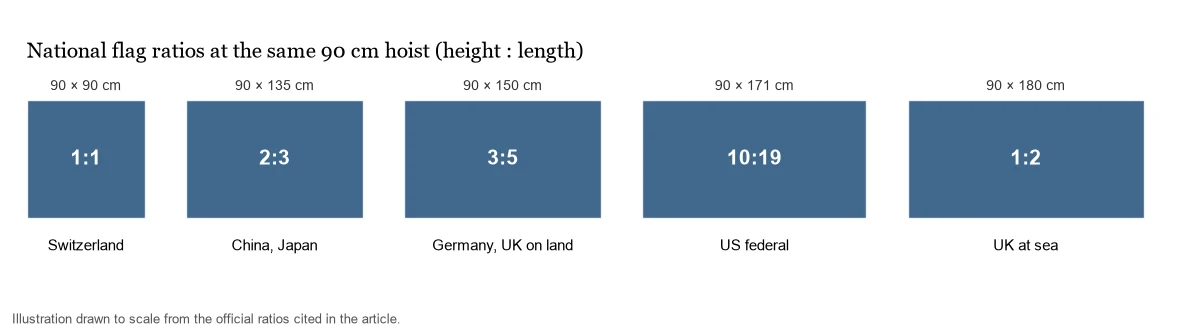
At the same hoist, the square Swiss flag has half the area of a 1:2 flag; matching areas evens that out. One large precedent for the first approach is the Olympic Games: according to swissinfo.ch, an IOC spokesperson said in 2018 that beginning with Athens 2004 all flags at the Games have had the same rectangular format, with Nepal’s flag the one exception, and Swiss athletes at the 2018 Winter Games carried a 2:3 flag “in keeping with the other nations”. For a row of event flags, one 2:3 cut for all follows that example; for an embassy or government client, ask whether each flag must keep its official ratio.
Frequently asked questions
What is the most common flag ratio?
2:3, used by roughly 85 national flags in Wikipedia’s list; 1:2 is second with between 50 and 60, and 3:5 third with about 20.
What is the ratio of the US flag?
10:19 for most federal sizes under Executive Order 10834. Flags sold at retail are usually 2:3, 3:5 or 5:8.
Which country has the longest flag?
Qatar, at 11:28, more than two and a half times as long as it is high.
Which national flags are square?
Switzerland’s, under Art. 3 of its Coat of Arms Protection Act, and Vatican City’s. Swiss athletes at the 2018 Winter Games carried a rectangular 2:3 flag, and flags at sea fall under separate Swiss rules.
What ratio are national flags at the Olympic Games?
One rectangular format for every country except Nepal since the 2004 Athens Games, according to the IOC as quoted by swissinfo.ch; Switzerland’s flag at the 2018 Games was 2:3, in keeping with the other nations.
Is a 4 × 6 ft flag the same shape as a 3 × 5 ft flag?
No. A 4 × 6 ft flag is 2:3 and a 3 × 5 ft flag is 3:5, so the 4 × 6 ft flag is relatively shorter. A 2:3 design fits a 4 × 6 ft flag exactly; in a 3 × 5 ft or 90 × 150 cm cut it becomes about 11% longer, and a 1:2 design about 17% shorter, than its official shape.
To order a matched set, send the countries, the size, hoist height or area you want, and whether each flag should keep its official ratio through our quote form. Our minimum for national flags is 100 per design.
Sources: Wikipedia’s list of national flags of sovereign states (ratios counted October 2026, approximate); Anordnung über die deutschen Flaggen (1996); the 1949 specification of the flag of the People’s Republic of China and its National Flag Law, Arts. 3 and 19; Japan’s Act on the National Flag and Anthem (1999); Switzerland’s Coat of Arms Protection Act, Art. 3; the Flag Institute’s Union Flag specification; Executive Order 10834; 4 U.S.C. § 7(g); swissinfo.ch (9 February 2018) for the Olympic format; our national flag product page, as of 20 October 2026. Ratios are height to length. Sizes, areas and percentages are our calculations.