Hang a flag flat on a wall by its grommets or heading on screws or hooks along a level line, or from a rod through its pole sleeve.
- Weight: a 90 × 150 cm (about 3 × 5 ft) flag weighs about 100–230 g of fabric
- Fixings: small hooks or removable adhesive hooks rated for that weight hold it indoors
- US flag: union uppermost and on the viewer’s left, horizontally or vertically
- Outside walls: use a wall-mounted flagpole and bracket instead
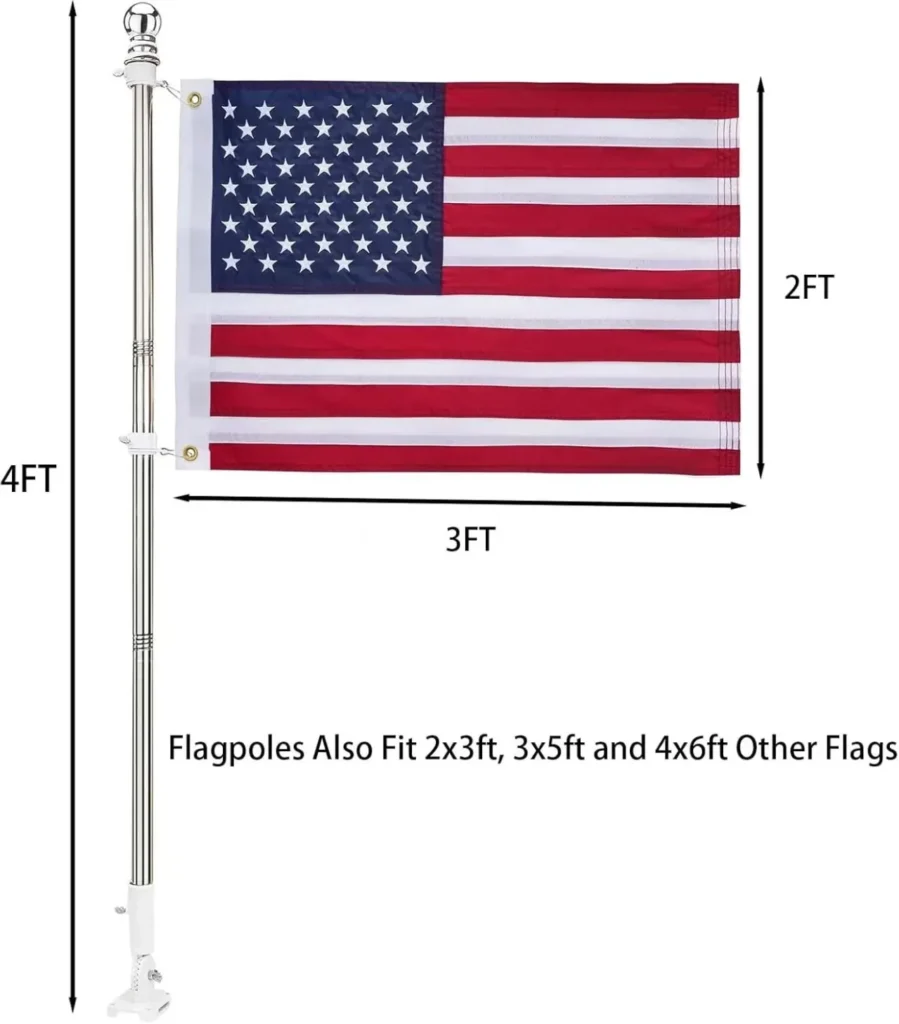
Hanging a flag flat against an indoor wall and flying it out from an outside wall are different jobs: the first depends on how the flag is finished along its edges, the second on the pole and bracket. Both are described below with the finishing and fabric details of the flags we make.
How do you choose a method for hanging a flag on a wall?
The way a flag is finished along its edge decides how it can be hung. Check which of these your flag has before you buy hooks or drill holes:
| Finishing | Where you find it | How to hang it flat on a wall |
|---|---|---|
| Webbing heading with two grommets | Our national flags, with webbing along the left (hoist) edge and two eyelets in it; our national-style wall flags also have webbing and grommets on the left side | Two screws or hooks at the eyelet spacing on the left; on their own they leave the fly end hanging, so add a pin or small clip at each right-hand corner, or hang the flag vertically from the two eyelets |
| Grommets in all four corners | Banners finished with grommets, and many decorative flags | Four screws or hooks set to the grommet spacing; the flag lies flat with no extra fixing |
| Pole sleeve | Feather and teardrop flags, and pennants made with a sleeve | Slide a dowel, curtain rod or tension rod through the sleeve and hang the rod on two hooks or brackets |
| Cord or ribbon | Bunting strings and pennants finished with a ribbon | Tie the cord or ribbon ends to two hooks |
| Hemmed edges only | Souvenir and decorative flags without hardware | Pins through the hem at the corners, or clips on a rod or wire; keep pins out of the printed area |
Finishings as supplied on our national flags, wall flags and banners; check your own flag before you fix anything to the wall.
Measure the distance between the grommets on the flag itself rather than working it out from the flag size, and mark the points on the wall along a level line before fixing anything.
Three methods need no holes at all. A tension rod can be wedged across an alcove or window recess and passed through a pole sleeve, with no fixings in the wall. Magnets hold a light flag flat: a small steel plate or magnet on the wall at each corner, with a second magnet on the front of the flag, which then shows. Hook-and-loop strips stuck to the wall and to the back of the heading or hem hold a flag that has no grommets, but the adhesive stays on the fabric.
How much does a flag weigh, and what will hold it on a wall?
A 90 × 150 cm flag weighs about 100–230 g of fabric, which is why small hooks and removable adhesive hooks work indoors. The weight of the fabric is its area times its weight per square meter. Our product pages list the weights of the fabrics in grams, which we read as grams per square meter: 70–80 g/m² for 100D polyester, 110–115 g/m² for 110 g/m² knitted polyester and 165 g/m² for spun polyester; our flag fabric guide compares the fabrics. The chart applies them to common flag sizes:
| Flag size | Area | 100D polyester | 110 g/m² knitted polyester | 165 g/m² spun polyester |
|---|---|---|---|---|
| 60 × 90 cm (about 2 × 3 ft) | 0.54 m² | 38–43 g | 59–62 g | 89 g (0.20 lb) |
| 90 × 150 cm (about 3 × 5 ft) | 1.35 m² | 95–108 g | 149–155 g | 223 g (0.49 lb) |
| 120 × 180 cm (about 4 × 6 ft) | 2.16 m² | 151–173 g | 238–248 g | 356 g (0.79 lb) |
| 150 × 240 cm (about 5 × 8 ft) | 3.60 m² | 252–288 g | 396–414 g | 594 g (1.31 lb) |
| 200 × 300 cm | 6.00 m² | 420–480 g | 660–690 g | 990 g (2.18 lb) |
Fabric only, from the weights listed on our product pages; heading, eyelets and stitching add to them.
These are fabric weights only. The webbing heading, eyelets and stitching add to them, and we have not weighed finished flags, so allow a margin. Even so, in these three fabrics the fabric of a 90 × 150 cm flag comes to about half a pound or less, so the fixing matters more than the weight. Oxford and satin, which we also make, are not in the chart because our pages do not give their fabric weights. Two points to watch:
- Removable adhesive hooks and strips carry the maker’s weight rating and a list of the wall surfaces they suit; check that the rating on the pack is above the flag’s weight for each hook. Picture-hanging strips are sold for frames, with a maximum frame size on the pack (for example 3M’s small picture-hanging strips), so for a flag use adhesive hooks and hang the grommets on them, rather than sticking strips to the fabric.
- Outdoors, wind pulls on a flat-hung flag far harder than its weight, so a flag on an outside wall needs screws into the wall or a proper flagpole bracket. For a US flag left out after dark, the Code allows 24-hour display only when it is properly lit (4 U.S.C. § 6(a)).
Ordering flags to hang on walls in several rooms or branches? Tell us how they will hang and the size of the wall. We reply with the size and finishing we would use, grommets, sleeve or heading, and the sample time.
Which way should a US flag face on a wall?
Hang a US flag with the union uppermost and on the viewer’s left, whether the flag is horizontal or vertical.
The US Flag Code, 4 U.S.C. § 7, sets the orientation. When the flag is displayed horizontally or vertically against a wall, the union, the blue field with the stars, goes uppermost and to the flag’s own right, which is the left of a person facing it. In a window, the union goes to the left of a person looking at it from the street.
- Horizontal on a wall: union in the top left corner as you face it.
- Vertical on a wall: hang the flag with the heading (the edge with the eyelets) at the top, so the stripes run up and down, and turn it so the union is at the top on your left. You now see the other face of the flag. Rotating a horizontal flag a quarter turn without turning it over puts the union at the top right or the bottom left, both wrong.
- On a pole projecting from a window sill, balcony or the front of a building: the union goes at the peak of the staff, unless the flag is at half-staff.
- Across a lobby or corridor of a building with one main entrance: hang it vertically, with the union on the left of a person entering.
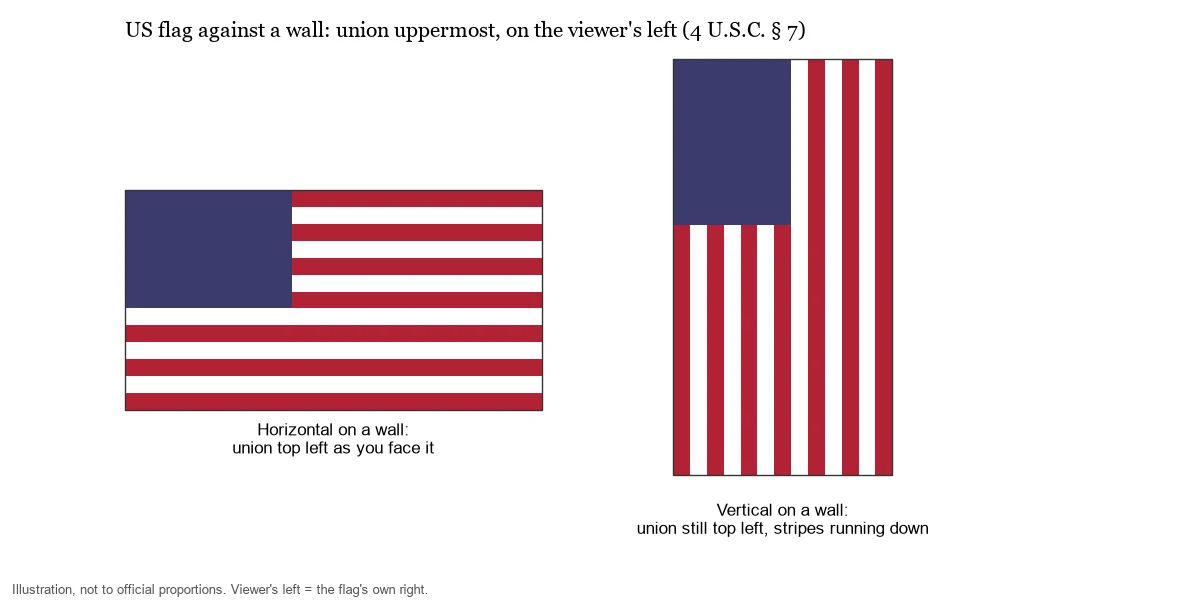
The Code also asks that the flag never touch the floor or anything beneath it, fall free rather than be draped or drawn up in folds, and not be fastened so that it can easily be torn (4 U.S.C. § 8(b), (d), (e)).
The Flag Code applies to the US flag. For other national flags, follow the rules of the country concerned; when several national flags are shown together, our guide to displaying international flags covers the order and spacing.
How do you hang a flag vertically?
Turn the flag so the hoist edge, the side with the grommets or sleeve, is at the top, check that the union sits at the top on the viewer’s left, and fix it along that top edge so the rest hangs free.
Check the space first. A 90 × 150 cm (about 3 × 5 ft) flag hung vertically needs a strip of wall about 90 cm wide and a little over 150 cm tall, with enough clearance below for the bottom edge to stay off the floor and any furniture.
- Turn the flag so the stripes run up and down and the grommets are along the top. For a US flag, look at it from where people will stand: the union must be in the top left corner. If it ends up top right, turn the flag over rather than rotating it again.
- Mark two fixing points level with each other, one under each grommet. A standard flag has two grommets on the hoist edge, so they now sit at the two top corners.
- Fix hooks, screws or nails at the marks and hang the flag from them. For a flag with a pole sleeve, slide a rod or dowel through the sleeve and rest it on two brackets instead.
- Step back and check that the flag hangs straight and clear of anything below it.
In a window, the rule applies from the street side: the union goes at the top left as seen from outside, so people inside see it at the top right.
Other flags follow the rules of the country or state that issues them. A flag with lettering, a coat of arms or another emblem can read sideways when turned, and some countries specify a separate vertical version, so check the official rules before hanging one vertically. For a custom flag or banner that will only ever hang vertically, design it upright and put the grommets or sleeve on the short top edge. Note “vertical hanging” and where the grommets should go on the quote form, and we confirm the finishing on the quotation.
How do you hang a flag from an outside wall?
To fly a flag from a shop front, an office or a balcony, the flag goes on a pole fixed to the wall with a bracket, so it can move in the wind instead of lying flat. Our wall-mounted flagpoles are supplied as kits: a stainless steel, aluminium or fiberglass pole with a ball top and a wall bracket fixed with screws and anchors. Mounting plates can carry a logo, and there is also a wall bracket for teardrop flags. Pole length is confirmed at quotation according to the flag size and where the pole is mounted.
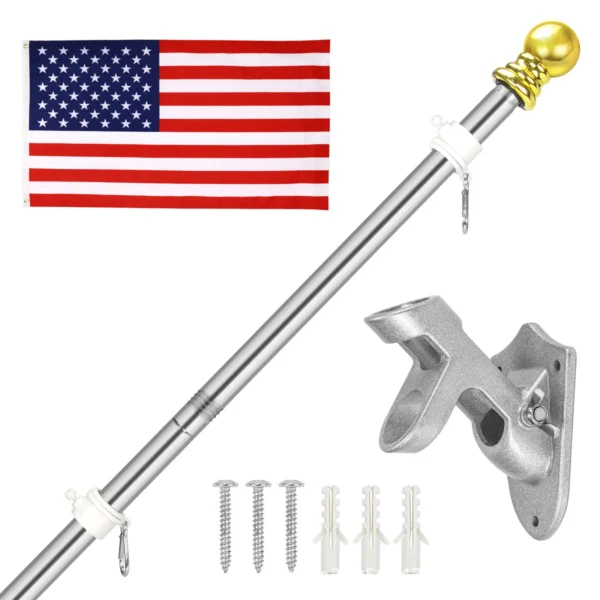
The flag and pole have to match. Our wall flags come in three typical styles, each with its pole length:
| Style | Typical flag size | Pole length |
|---|---|---|
| Teardrop shape on a wall bracket | 35 × 43 × 56 cm | 70 cm |
| Beach-flag style | 40 × 100 cm | 140 cm |
| National flag style, with webbing and grommets | 90 × 150 cm (about 3 × 5 ft) | 180 cm |
Sizes as listed on our wall-mounted flagpole page; every style can be made to a custom size.
Sizes can be customized for every style. For a US flag on a projecting pole, the union goes at the peak of the staff. On an outside wall, fix the bracket into solid masonry or a structural member with anchors suited to the wall, and check that the flag clears windows, signs and passers-by when it hangs straight down in still air.
Frequently asked questions
How do I hang a flag on a wall without nails?
Use removable adhesive hooks through the grommets, a tension rod through a pole sleeve, or magnets at the corners. A 90 × 150 cm flag in 100D, knitted or spun polyester weighs about 100–230 g of fabric; check that the rating on the hook pack is above the flag’s weight for each hook, and that the pack lists your wall surface.
Will adhesive strips hold a flag?
Adhesive hooks will hold a light indoor flag hung by its grommets. Picture-hanging strips are designed for frames, so stick them to a rod or frame that carries the flag rather than to the fabric itself.
How do you hang a flag on a wall without grommets?
If it has a pole sleeve, put a rod through it and hang the rod. If it has only hemmed edges, pin through the hem at the corners or clip it to a rod or wire, keeping pins out of the printed area. When you order, ask for the finishing you need: our national flags have two eyelets in the webbing heading as standard, and banners can be finished with grommets.
Which way should a US flag hang on a wall?
With the union uppermost and on the flag’s own right, the viewer’s left, whether it hangs horizontally or vertically, under 4 U.S.C. § 7.
Can you hang any flag vertically?
Most flags can be hung vertically from the grommets on the hoist edge, but it is not always correct. A US flag can, with the union at the top on the viewer’s left. Flags with lettering or emblems read sideways when turned, so check the issuing country’s rules or order a version designed to hang upright.
Should a US flag be on the left or right of the house?
The Flag Code does not name a side of the house or door for a single flag. It sets the flag’s position instead: on a pole projecting from the front of a building the union goes at the peak of the staff, and flat against the wall or in a window the union is on the left as seen from the street (4 U.S.C. § 7(h) and (i)). If another flag is flown beside it at the same height, the US flag goes on its own right, which is the left as seen from the street (§ 7(c)).
What is the best way to hang a large flag on a wall?
Fix it at more points. A 150 × 240 cm flag in spun polyester weighs about 600 g of fabric, still light, but its long top edge can sag between two fixings. Use a rod through a sleeve or along the heading, or a fixing at every grommet, and screws into the wall rather than adhesive hooks.
To order flags with the finishing that suits your display, or wall-mounted poles and brackets, send the flag size, finishing and quantity through our quote form. Minimums are 100 per design for national flags and 20 for wall-mounted flagpoles. Retailers stocking flags for wall display can choose the finishing in the order: national flags come with a webbing heading and two eyelets, and banners can be finished with grommets. Wall flags start from 100 pieces.
Sources: the US Flag Code, 4 U.S.C. §§ 6, 7 and 8, via Cornell Law School’s Legal Information Institute; 3M’s product page for small picture-hanging strips; our national flag, wall flag, wall-mounted flagpole and custom banner product pages for finishing, sizes and fabric weights, as of 20 October 2026. Fabric weights are listed on our product pages in grams and taken here as grams per square meter; flag weights are our calculations from fabric weight and area, not weighed samples. The diagram is an illustration.