Fly each nation’s flag on its own pole, with every pole the same height and every flag about the same size.
- Position of honor: in the US and UK, the host nation’s flag, on the first pole on the observer’s left
- Order: the other nations follow in English alphabetical order; UK protocol writes it down, and in the US it is usual practice
- Other countries: use their own order; German federal rules sort foreign flags by their German names
- Before you fix the order: check the host country’s protocol
Which flag display rules do US and UK protocol share?
US and UK protocol share four rules: one national flag per pole, poles of the same height, flags of about equal size, and no nation’s flag above another in peacetime.
| Rule | Source |
|---|---|
| One national flag per pole | 4 U.S.C. § 7(g): flags of two or more nations “are to be flown from separate staffs” |
| Poles of the same height | 4 U.S.C. § 7(g); Flag Institute (UK) |
| Flags of about equal size | 4 U.S.C. § 7(g); Flag Institute; German federal decree of 22 March 2005 |
| No nation’s flag above another in peacetime | 4 U.S.C. § 7(g): “International usage forbids the display of the flag of one nation above that of another nation in time of peace” |
Some flag guides, and Google’s AI summary for this search in October 2026, say the host nation’s flag may be “slightly elevated.” It should not: the US Flag Code and the Flag Institute both say no nation’s flag flies above another’s, and the Flag Institute names medal ceremonies at sporting events as the only exception. Using the same pole model throughout also keeps the flags level.
In which order should national flags be displayed?
The host country sets the order, and the three protocols below do not agree.
| United States | United Kingdom | Germany (federal buildings) | |
|---|---|---|---|
| Position of honor | First pole on the observer’s left | First pole on the observer’s left; the center of a semicircle | The left side as seen from outside the building |
| Host nation’s flag | US flag in the position of honor | Union Flag, then the flag of the host country (England, Scotland, Wales and so on) | After international organizations and foreign states |
| Other nations | English alphabetical order by common practice (not set by the Flag Code) | English alphabetical order | Alphabetical by the official German short names |
| Organization flags | Never equal to, above or in a superior position to the US flag | UN, Commonwealth and Council of Europe flags after the nations | International and supranational organizations first |
| Source | 4 U.S.C. § 7(c), (g) | Flag Institute, British flag protocol | Federal government decree on flags at federal buildings, 22 March 2005 |
Summaries of each country’s published practice; check the current text before an official occasion.
Germany’s federal government decree on flags at federal buildings (22 March 2005) lists the order from the preferred position as: flags of international and supranational organizations; flags of foreign states “in alphabetischer Reihenfolge der amtlichen deutschen Kurzbezeichnung” (in alphabetical order of their official German short names); the federal flag; the flags of the German states; and municipal flags. The same decree says that where several flags fly at one building, they should be the same size.
For a semicircle, the Flag Institute puts the senior national flag in the center, the next flag on the left of the central flag, the next on its right, and so on, alternating outward. If only one flag flies and the other poles stay empty, it goes on the observer’s left when there are two poles, and as near the center as possible when there are more.
Write the order on the site plan before the flags arrive. That way the installation team works from the plan, not from memory.
How do you display the US flag with other countries’ flags?
Two sections of the US Flag Code apply together here. 4 U.S.C. § 7(g) says flags of two or more nations fly from separate staffs of the same height and should be of approximately equal size. § 7(c) says no other national or international flag may be displayed “equal, above, or in a position of superior prominence or honor to” the US flag, with an exception for the long-standing practice at United Nations Headquarters. Put together, every flag flies at the same height and size, and the US flag takes the position of honor: the first pole on the observer’s left, which is the flag’s own right.
Two more cases come up at events. Against a wall with crossed staffs, the US flag goes on its own right, with its staff in front of the other flag’s staff (§ 7(d)). On a stage or in an auditorium, the US flag stands “in the position of honor at the clergyman’s or speaker’s right as he faces the audience”, and other flags go on the speaker’s left (§ 7(k)).
How should national flags be displayed indoors?
The same rules apply indoors on a smaller scale: one flag per stand, stands of the same height and flags of the same size.
| Option | Senior Flags sizes | Stand |
|---|---|---|
| Table flags | 10 × 15 cm, 20 × 30 cm or custom | 30, 35 or 42 cm plastic or metal pole with base |
| Desk flag stands | For 14 × 21 cm and 15 × 21 cm flags | Single, horizontal arm, or Y-shaped double stand |
Sizes as listed on our table flag and desk flag stand product pages.
Our desk stands are made for 14 × 21 cm and 15 × 21 cm flags, while our standard table flags are 10 × 15 cm and 20 × 30 cm. If you order both, ask for the flags at the stand size, or for a pole matched to your flag size at quotation. Both start at 100 pieces.
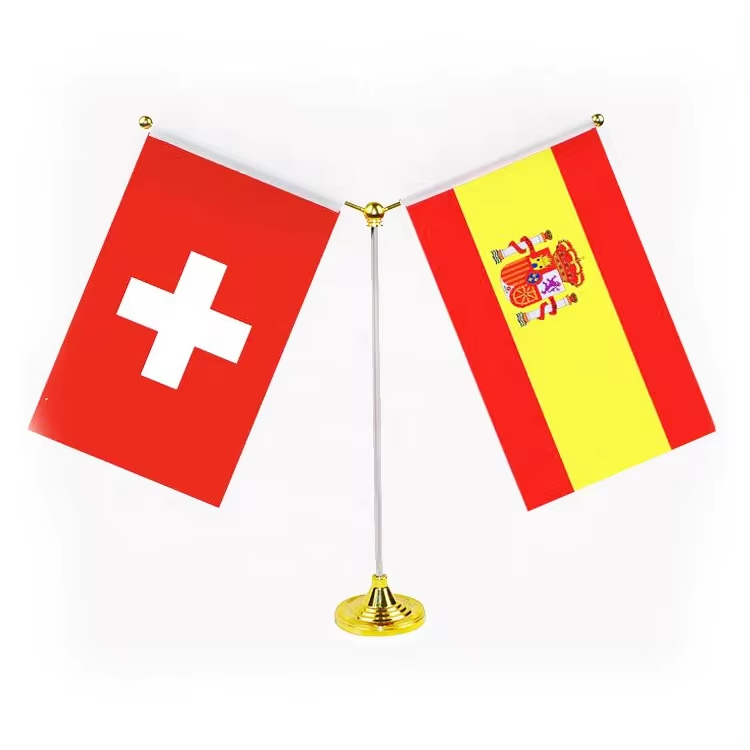
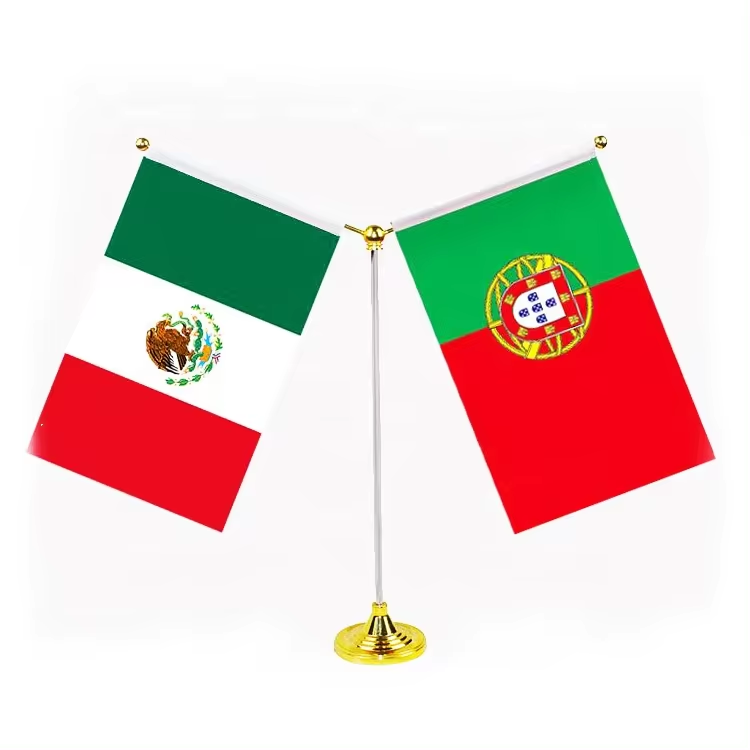
A Y-shaped double stand holds two flags on one base. In the US, put the US flag on its own right, the observer’s left. For three or more countries, use single stands in a row, in the same order as an outdoor line.
Not sure how to make a line of flags look equal? Send the list of countries and the size you have in mind. We reply with the size and proportion we would use for each flag, and the sample time.
How do you order a matched set of national flags?
Order every country in one size and one fabric, and say whether each flag should keep its official proportion.
National flags at Senior Flags
We make national flags of any country from 60 × 90 to 200 × 300 cm, in the fabrics compared in our flag fabric guide, each with a webbing heading and two eyelets on the hoist side. Without a color reference, we print to the flag’s standard Pantone references. The minimum is 100 flags per design.
| Item | What to specify | Why |
|---|---|---|
| Size | One size for every country, for example 90 × 150 cm | Equal size is part of every protocol above |
| Proportions | All flags at one proportion, or each at its official proportion with the same hoist width | Some countries’ official proportions differ from the common sizes |
| Design version | The version of each flag where more than one is in use | Some countries fly a different state or civil flag: German federal authorities, for example, fly the federal service flag (Bundesdienstflagge), while other public bodies fly the plain federal flag (Bundesflagge) |
| Colors | Pantone references, or our standard references accepted in writing | Keeps colors consistent between flags and between reorders |
| Sides | Single-sided or double-sided | A single-sided flag shows a mirror image on the back, so lettering, such as the motto on Brazil’s flag, reads backwards from one side; our double-sided national flags are silk screen printed on both sides (single-sided vs double-sided flags) |
| Finishing | Webbing and eyelets to match your pole clips | Saves refitting on site |
| Quantity per country | Number of each design | The minimum applies per design |
| Poles | Same height, same model | Outdoor flagpole heights are made to order |
There are two ways to make a line of national flags look equal. The Flag Institute recommends making every flag in 3:5 proportion when one standard size is needed for the whole display. If each flag keeps its official proportions, make them to the same width, the measurement from top to bottom; flags that are square or nearly square, such as those of Switzerland and Vatican City, can be “up to 25% more” in that width to give a more equal area. Say on the order which method you want, because it changes the cutting size of every flag. Our standard flag size chart lists the common flag sizes in feet and centimeters side by side.
Send the country list with a reference image for each design; our artwork and proof checklist explains what to check before you confirm.
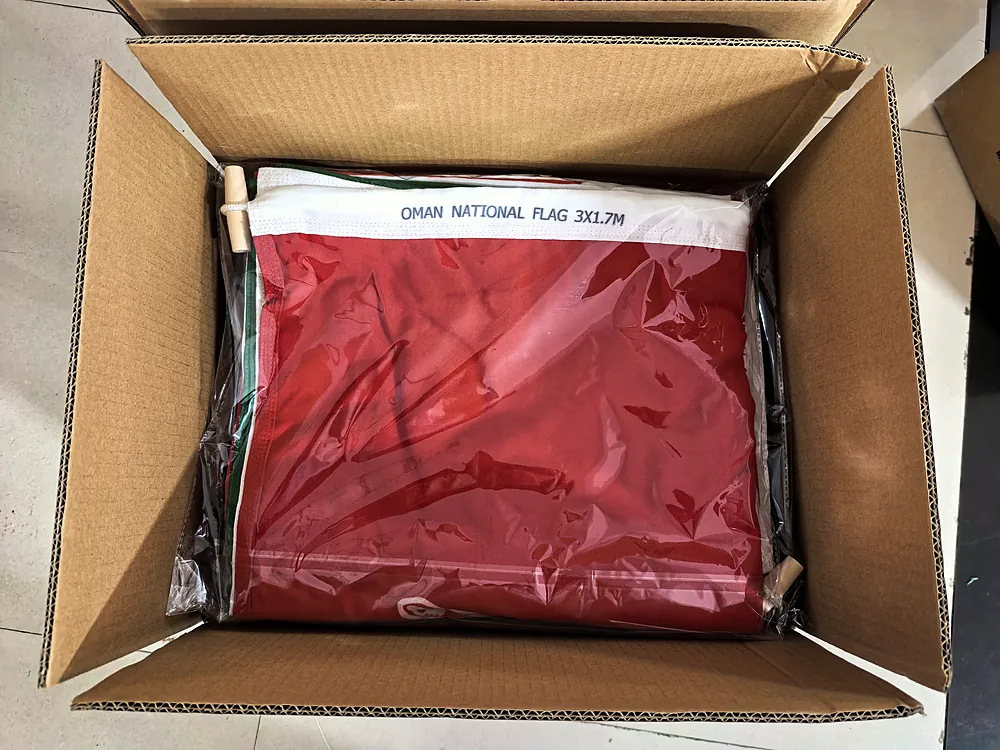
Our minimum is 100 flags per design. For a display of 32 countries, that means 3,200 flags at minimum. That volume suits distributors and retailers who stock country flags, not a single event that needs one or two of each. At our standard packing of 150 flags to a carton, for 90 × 150 cm flags in 100% polyester, 3,200 flags of that size fill about 22 cartons; for other sizes and fabrics the carton count is confirmed at quotation. If you need only a few flags of each country, ask about mixed orders before you plan the budget.
Our outdoor flagpoles are made in aluminum alloy or stainless steel with the height confirmed at quotation, from a minimum of 20 poles, which lets you order a full line at one height. A line of fewer than 20 poles falls below that minimum, so give the pole count when you ask for a quote.
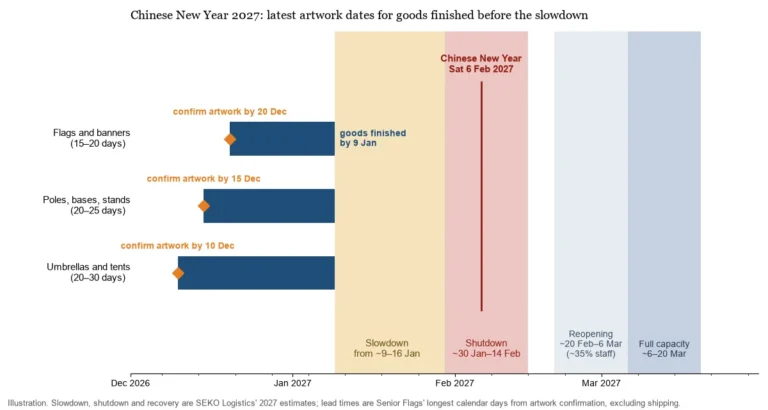
Samples take 5 to 7 calendar days and flag production 15 to 20 calendar days, both counted from artwork confirmation and excluding shipping. Poles take 20 to 25 calendar days. A national flag sample costs, for example, USD 80 excluding freight, and the fee can be credited against the bulk order; the sample price for your design is confirmed at quotation. Minimums and lead times for every product are in custom flag MOQ and lead times. If you are buying from a factory for the first time, see how to check a Chinese flag factory.
Frequently asked questions
How do you display the US flag with other countries’ flags?
Fly each flag on its own pole of the same height and at about the same size, with the US flag in the position of honor: the first pole on the observer’s left, which is the flag’s own right.
Can the US flag be flown at the same height as other countries’ flags?
Yes. Under 4 U.S.C. § 7(g), flags of different nations fly at the same height on separate poles and at about the same size. § 7(c) still keeps the US flag in the position of honor, so no foreign flag stands in an equal or superior position of honor.
Can the host country’s flag fly higher than the others?
No. International usage forbids one nation’s flag above another’s in peacetime. The Flag Institute makes an exception only for medal ceremonies at sporting events.
What is the only flag that can fly above the US flag?
Under 4 U.S.C. § 7(c), the church pennant may fly above the US flag during church services conducted by naval chaplains at sea. The same section also allows the long-standing practice at United Nations Headquarters, where the UN flag holds the position of superior prominence.
Which position is the position of honor?
In a line, the observer’s left, which is the flag’s own right. In a semicircle, the center.
What order should international flags be in?
It depends on the host country. In the US and UK, the host flag comes first and the other nations follow in English alphabetical order. German federal rules put international organizations first, then foreign states by their German names, then the German flag.
Do all the flags have to be the same size?
Yes, about the same. Order the set at one size, either all at one proportion or all at the same width with each country’s official proportions.
Planning a display of country flags? Send the list of countries, the size and the quantity per country, and we will quote the flags and poles as one matched set. Request a quote
By the Senior Flags editorial team, prepared with AI assistance. Protocol sources checked on 10 October 2026: 4 U.S.C. § 7 (Cornell LII), the Flag Institute’s UK flag protocol and the German federal government decree of 22 March 2005. Company details were confirmed by Senior Flags in October 2026.