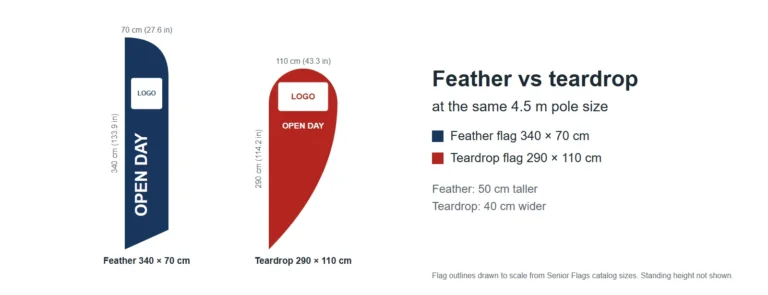
Hang bunting outside by tying the ends to solid points with cable ties or cord, leaving slight slack and keeping each span short.
- Fixings: cable ties, cord, hooks or brick clips, chosen by the surface
- Material: polyester or PVC outdoors; felt and paper indoors
- Wind: shorten long spans, and take bunting down before strong winds
- Length: measure the route the bunting follows, then add allowances
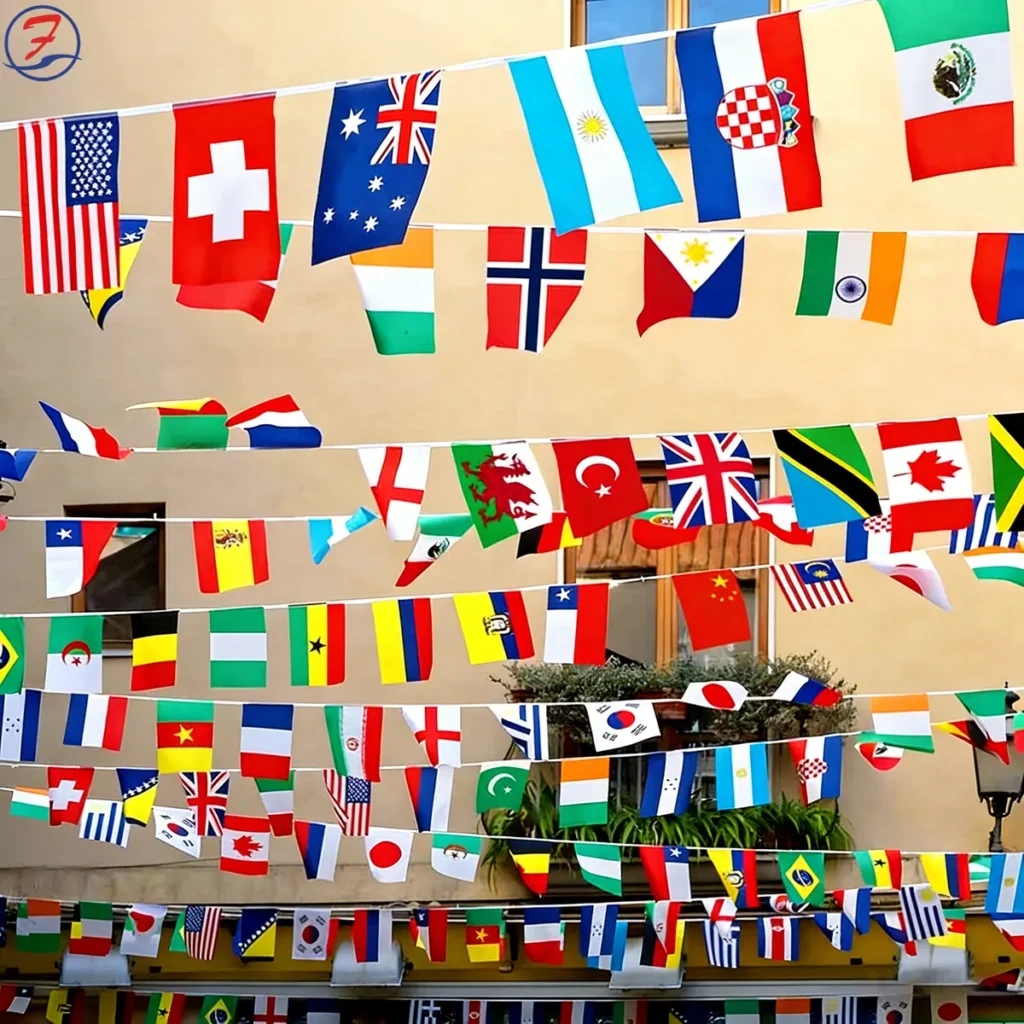
From our factory
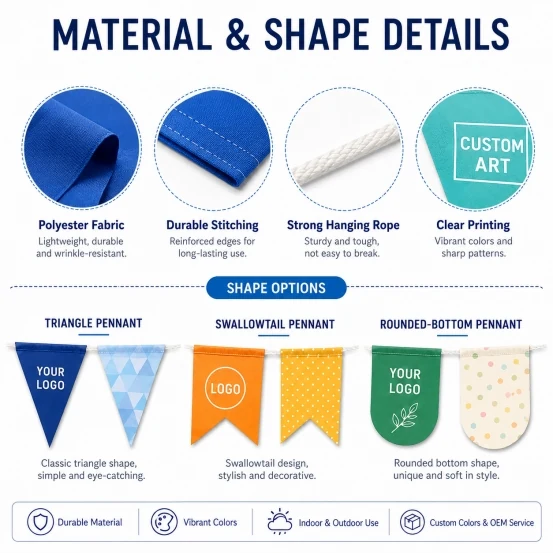
Senior Flags has made flags in Lu’an, Anhui, since 2003. Our bunting comes in 68D polyester, 110 gsm knitted polyester, felt, PVC and coated paper; fabric pennants have stitched edges on a braided rope, and each string is packed in its own polybag.
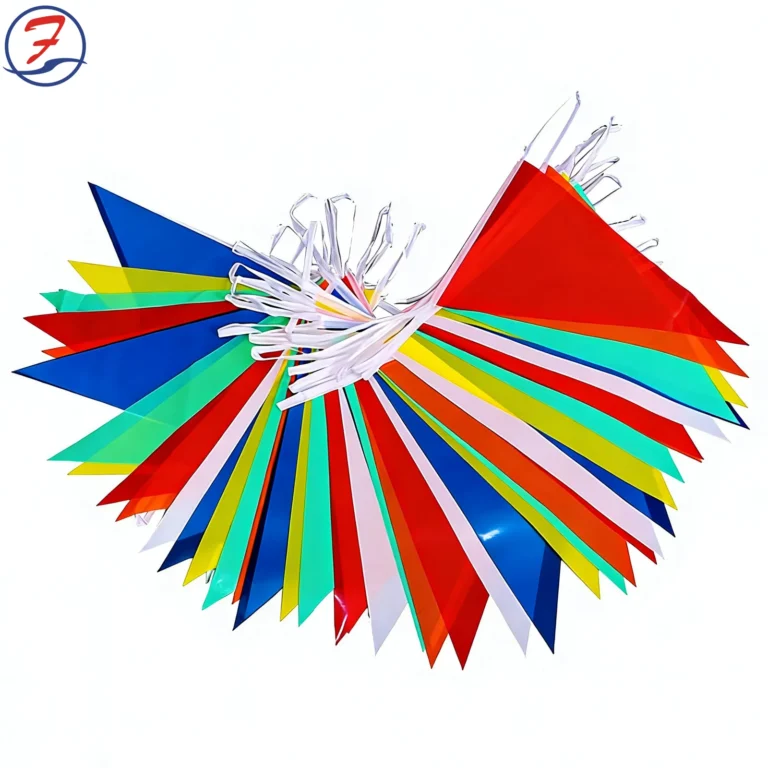
“Bunting” here means a string of small pennants, usually triangles, on a tape or cord. In the US the same word often means pleated red, white and blue fans hung on porches. This guide is about strings, but the fixing and wind advice applies to both.
Hanging pleated fan bunting? Fan bunting usually has grommets along its top edge. Tie each grommet tightly to the rail or fence, because the ties loosen over time, and hold the bottom edge down as well: one home decorator clipped curtain rings to the bottom, threaded a string through them and tied it to a post (Thistlewood Farms).
How much bunting do you need?
Measure the actual route the bunting will follow, not the straight line between fixing points, then add allowances:
- Measure each run. Walk the route with a tape: along the storefront, across the gap between two posts, around the stall.
- Add drape. Bunting pulled tight looks stiff and strains the fixings. For runs along a wall, Feel Good Times suggests adding about a third to the wall length, so a 3 m (10 ft) wall takes 4 m (13 ft) of bunting.
- Add tails for tying off. The same guide allows about 20 cm (8 in) beyond each fixing point.
- Add spares. Order an extra string or two for repairs and for the run you forgot to measure.
For tents and marquees, rental companies publish layout tables by tent size. UK supplier Beautiful Bunting’s rough estimates, for example, run from 10-20 m for a 3.6 × 3.6 m marquee to 100 m for one of 36 × 12 m (about 33-66 ft for a 12 × 12 ft tent, up to about 330 ft for a 120 × 40 ft one).
If you are ordering custom bunting, give the supplier the total length in meters or feet and the longest single run. The number of pennants and the spacing along each string depend on the pennant size, and we confirm both with the quotation.
How do you fix bunting outdoors?
Choose the fixing by the surface: ties or cord on railings, hooks on wood, clips on brick and a support line between trees.
| Surface | Fixing |
|---|---|
| Fence or railing | Cable ties or cord around the posts, not the panels |
| Wood porch, fascia or pergola | Cup hooks or screw hooks |
| Brick | Brick clips that grip the brick, with no drilling |
| Gutter | Outdoor gutter hooks |
| Trees or open ground | A taut support line between trees or staked poles, with the bunting tied along it |
| Glass | Suction-cup hooks, for light bunting only |
General fixing practice. Check the venue’s or property owner’s rules before fixing anything to their structures.
To join two strings, tie the end loops together and put a support at the join.
Use mechanical fixings. Cable ties, cord, and cup or screw hooks in wood hold in wind. Adhesive hooks sold for outdoor use suit light decorations on smooth, clean surfaces, but on an exposed run they are the first fixing to fail. As Feel Good Times puts it, “wind pulls anything adhesive straight off.”
Tie through the loops, not through the pennants. Pushing pins or staples through the fabric starts tears. A UK rental company, The Event Flag Hire Company, tells customers to never cut the bunting or use pins or staples.
Keep spans short. Long unsupported spans swing more and pull harder on the end fixings. Two UK bunting suppliers give different limits: The Event Flag Hire Company uses a maximum of 8 m (26 ft) between bamboo poles, while Feel Good Times recommends outdoor runs of no more than 5 m (16 ft). On an exposed site, use the shorter figure, or add an intermediate support.
Start in the middle. Fix the center of a long run first, then work towards each end. It keeps the drape even.
Leave headroom. Indoors, Feel Good Times suggests at least 2.1 m (7 ft) at the lowest point for bunting strung across a room. Outdoors, hang it well above head height and clear of vehicles.
Ask before fixing to public property. If the run crosses a road or uses lamp posts, check with the property owner and the local authority first: the council in the UK, the city or county permit office in the US.
Which bunting material survives outside?
PVC and polyester bunting survive outside; felt and coated paper are better kept indoors. For fabric weights in more detail, see our flag fabric guide.
| Material | Outdoors? | Notes |
|---|---|---|
| PVC | Yes | Plastic sheet; does not absorb rain; suits wet-weather displays, storefronts and car lots |
| 68D polyester | Yes | Light woven polyester; dries faster than felt |
| 110 gsm knitted polyester | Yes | Knitted polyester, 110 g per m² |
| Felt | Better indoors | Soft decorative look; absorbs water |
| Coated paper | Indoors or one-off | For decoration and short promotions |
Outdoor suitability is a general comparison of the materials, not the result of a weathering test.
Two things wear outdoor bunting: sun, which fades the print over time, and flapping, which wears the corners and stitching. Taking bunting down between events reduces both, and checking the corners before each use catches wear early.
One side or both?
Bunting along a wall or shop window is seen from one side, so single-sided printing is enough. Bunting strung across a street, hall or playground is seen from both directions, and double-sided printing keeps the colors strong on both sides. If the pennants carry a logo or lettering, ask how it reads from behind. More on the difference in single vs double-sided flags.
Not sure how to split a long route? Send the route measurements, or a sketch with the fixing points marked. We reply with the string lengths and support points we would use, the pennant size, and the sample time.
How do you stop wind damaging outdoor bunting?
Bunting is light, but a long string catches a lot of wind, so check the forecast and take it down if strong winds are expected. A broken fixing lets a whole string swing into people or traffic. If pennants keep flipping over the cord, shorten the span or add an intermediate tie.

Bring fabric bunting in when the event ends rather than leaving it up wet. A soaked string can take days to dry and should be fully dry before it goes into storage.
What fire safety rules apply to bunting in venues and tents?
In the UK, decorations are part of a venue’s fire risk assessment. The Home Office guide for small and medium places of assembly lists drapes, hangings and banners as sources of fuel, says items that may be a source of fuel “should never be located on any corridor or stairway”, and asks for display materials to be fire-retardant or treated. The guide for open-air events and venues says fabrics, drapes and similar features inside marquees and temporary structures should be non-combustible or durably or inherently flame-retardant, and that chemically treated marquee fabric is affected by weathering and needs periodic re-treatment.
Event rules vary. The contractor instructions for one trade show at the NEC in Birmingham, for example, say hangings must be inherently or durably flame-proofed to BS 5867-2 or treated with a flame retardant, with test certificates available for inspection. In the US, the local fire code and fire marshal set the rules for decorations in assembly spaces, and fabric decorations are often required to pass the NFPA 701 flame propagation test. If your venue needs flame-retardant bunting, say so before production: the fabric and the paperwork have to be planned before the bunting is made, and we confirm per project what can be supplied. Wherever it hangs, keep bunting clear of exits, escape routes, lights and heat.
How do you store bunting for next season?
Store bunting completely dry, wound onto card or a reel, with one string per labeled bag.
- Dry it completely first. Fabric bunting washes like a flag; see our flag care guide.
- Wind each string onto a piece of card or a reel so the cord does not tangle.
- Keep strings in separate bags with the length written on the outside. Each string ships in its own polybag; if you reuse the bags, make sure the bunting is completely dry first.
- Check corners and ties before the next event and replace damaged strings rather than knotting them.
What do you need to order custom bunting in bulk?
A custom bunting run lets towns, schools, event companies, car dealerships and retailers choose the colors, logo and pennant shape. Send these details with your enquiry:
- Pennant size: 10 × 15, 15 × 20, 20 × 30 or 30 × 45 cm (about 4 × 6, 6 × 8, 8 × 12 or 12 × 18 in), or a custom size
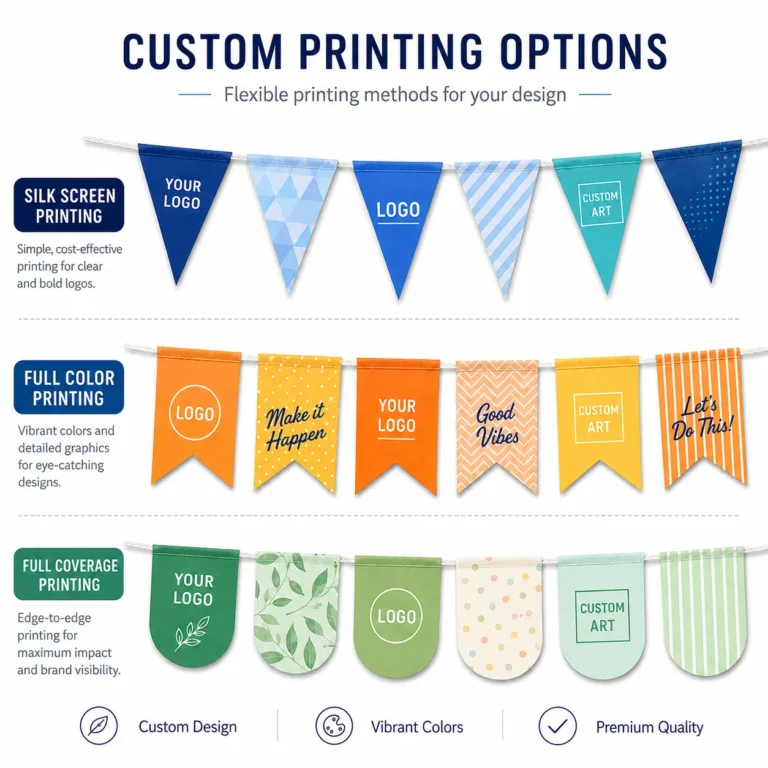
- Shape: triangle, swallowtail or rounded-bottom
- Material: PVC, 68D polyester, 110 gsm knitted polyester, felt or coated paper
- Printing: one side or both sides, by heat transfer or silk screen printing
- Total length and longest single run, so we can propose the string length and pennants per string
- Total quantity, delivery address and date
- Any fire safety paperwork your venue requires
MOQ for custom bunting is 100 individual flags, not 100 strings; how many flags go on each string is confirmed on the quotation. Samples take 5-7 calendar days and production 15-20 calendar days, both counted from artwork confirmation, plus shipping. Ocean freight from China takes roughly 15-20 days port to port to the US West Coast, 30-40 days to the East Coast and 40-50 days to UK ports while most sailings route around the Cape of Good Hope; air freight takes 1-5 days airport to airport. For decorations needed in a particular season, confirm the artwork early. Our guide to MOQ and lead times explains how the schedule is counted and lists typical shipping times with sources.
 MOQ 100 flagsWholesale Bunting FlagsSenior Flags makes custom bunting in 68D or 110 g/m² knitted polyester, polyester felt, coated paper or PVC, with pennants from 10 × 15 cm to…View specifications →
Frequently asked questions
What is the best way to hang bunting outside?
Tie it to solid fixing points with cable ties or cord through the end loops, leave some slack so it drapes, keep spans short, and fix the center of long runs first.
How do you hang bunting without nails or drilling?
Use cable ties or cord around existing posts, railings or trees, gutter hooks on a gutter, or brick clips on brick. Adhesive hooks are the first fixing to fail in wind, so keep them for light, sheltered runs.
How far apart should the fixing points be?
Bunting suppliers suggest 5-8 m (16-26 ft) at most between supports outdoors. Use shorter spans on exposed or windy sites.
Is polyester bunting waterproof?
Polyester does not soak up water the way cotton or felt does and dries quickly, but it is not waterproof in a strict sense. PVC bunting does not absorb water at all.
Does bunting need to be flame-retardant?
It depends on the venue and the country. UK fire safety guidance asks venues to keep decorations out of escape routes and to use flame-retardant materials where decorations add to the fire risk. In the US, the local fire code and fire marshal decide, and fabric decorations in assembly spaces are often required to pass NFPA 701. Get the requirement in writing before you order and send it with your enquiry; we confirm per project what can be supplied.
How long does custom bunting take to make?
At Senior Flags, sampling takes 5-7 calendar days and production 15-20 calendar days, both counted from artwork confirmation. Shipping time depends on the destination and method.
Planning bunting for a venue, downtown district or retail chain? Tell us the total length, pennant size, material and delivery date, and we will quote with string lengths and packing details. Request a quotation
Spacing, fixing and fire-safety guidance comes from the sources linked in the text (event and bunting suppliers, UK government fire-risk guides for places of assembly and open-air events, and NFPA 701), read in October 2026. Production times were confirmed by Senior Flags in October 2026 and are confirmed per order on the quotation.