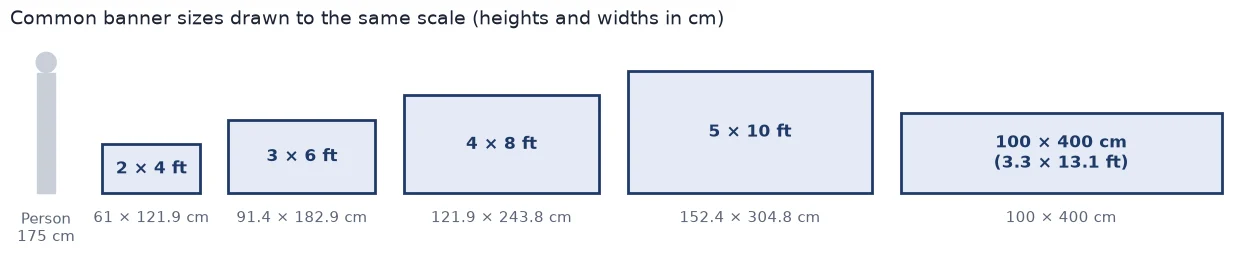
The most common printed banner sizes are 2 × 4 ft, 3 × 6 ft and 4 × 8 ft.
- Read up close: 2 × 3 and 2 × 4 ft
- Mid-size: 3 × 5 to 4 × 6 ft
- Read from a distance: 4 × 8 ft and up
- Retractable stands: about 33.5 × 80 in
- Metric: 3 × 6 ft is 91.4 × 182.9 cm; 100 × 400 cm is common for fences and sports grounds
The sizes here are for printed banners; web banner ad sizes such as 728 × 90 pixels follow a different standard. Metric figures are exact conversions (1 ft = 30.48 cm), rounded to 0.1 cm.
What are the standard banner sizes in feet, inches and centimeters?
Standard banner sizes run from 2 × 3 ft (61 × 91.4 cm) for close reading to 4 × 8 ft and larger for distance.
The size names below are the ones US print shops use: Vistaprint, 4over4 and UPrinting list them, and 2 × 8 ft is a size buyers search for by name. The last column is our own calculation, explained in the next two sections: how far away a 20-letter message on that banner can be read, from the cautious print-shop rule to the US Sign Council’s average legibility value.
| Banner size | Inches | Centimeters | Area | 20-letter message readable to about (print-shop rule – USSC average) |
|---|---|---|---|---|
| 2 × 3 ft | 24 × 36 | 61.0 × 91.4 | 0.56 m² (6 sq ft) | 42–125 ft (13–38 m) |
| 2 × 4 ft | 24 × 48 | 61.0 × 121.9 | 0.74 m² (8 sq ft) | 48–144 ft (15–44 m) |
| 3 × 5 ft | 36 × 60 | 91.4 × 152.4 | 1.39 m² (15 sq ft) | 66–197 ft (20–60 m) |
| 2 × 6 ft | 24 × 72 | 61.0 × 182.9 | 1.11 m² (12 sq ft) | 59–176 ft (18–54 m) |
| 3 × 6 ft | 36 × 72 | 91.4 × 182.9 | 1.67 m² (18 sq ft) | 72–216 ft (22–66 m) |
| 4 × 6 ft | 48 × 72 | 121.9 × 182.9 | 2.23 m² (24 sq ft) | 83–249 ft (25–76 m) |
| 2 × 8 ft | 24 × 96 | 61.0 × 243.8 | 1.49 m² (16 sq ft) | 68–204 ft (21–62 m) |
| 3 × 8 ft | 36 × 96 | 91.4 × 243.8 | 2.23 m² (24 sq ft) | 83–249 ft (25–76 m) |
| 4 × 8 ft | 48 × 96 | 121.9 × 243.8 | 2.97 m² (32 sq ft) | 96–288 ft (29–88 m) |
| 5 × 8 ft | 60 × 96 | 152.4 × 243.8 | 3.72 m² (40 sq ft) | 107–322 ft (33–98 m) |
| 4 × 10 ft | 48 × 120 | 121.9 × 304.8 | 3.72 m² (40 sq ft) | 107–322 ft (33–98 m) |
| 5 × 10 ft | 60 × 120 | 152.4 × 304.8 | 4.65 m² (50 sq ft) | 120–360 ft (37–110 m) |
| 6 × 10 ft | 72 × 120 | 182.9 × 304.8 | 5.57 m² (60 sq ft) | 131–394 ft (40–120 m) |
| 6 × 12 ft | 72 × 144 | 182.9 × 365.8 | 6.69 m² (72 sq ft) | 144–432 ft (44–132 m) |
| 8 × 8 ft (step and repeat) | 96 × 96 | 243.8 × 243.8 | 5.95 m² (64 sq ft) | Photo backdrop, read up close |
| 8 × 10 ft (step and repeat) | 96 × 120 | 243.8 × 304.8 | 7.43 m² (80 sq ft) | Photo backdrop, read up close |
| 100 × 400 cm | 39.4 × 157.5 | 100 × 400 | 4.00 m² (43 sq ft) | 111–334 ft (34–102 m) |
| Retractable stand | 23.5, 33.5 or 47 × 80 | 59.7, 85.1 or 119.4 × 203.2 | about 1.7 m² at 33.5 in wide | Indoor, read up close |
Converted at 1 ft = 30.48 cm. Readable distances use the two letter-height rules explained in the next section.
Three sizes need a note. 100 × 400 cm is the common size on our custom banners page, which lists shop frontages, construction hoardings and sports grounds as typical uses; in feet it is 3.28 × 13.12 ft, so it is not the same as a 3 × 13 ft banner, and a frame built to one will not fit the other exactly. Step-and-repeat backdrops are sized for photographs taken a few feet away, so the distance rule does not apply to them. Retractable prints vary by a few inches between stand makers (UPrinting lists 23.5, 33.5 and 47 in widths at 80 in tall; 4over4 lists 33 × 81 in), so take the print size from the stand you will use.
How big should banner letters be for the viewing distance?
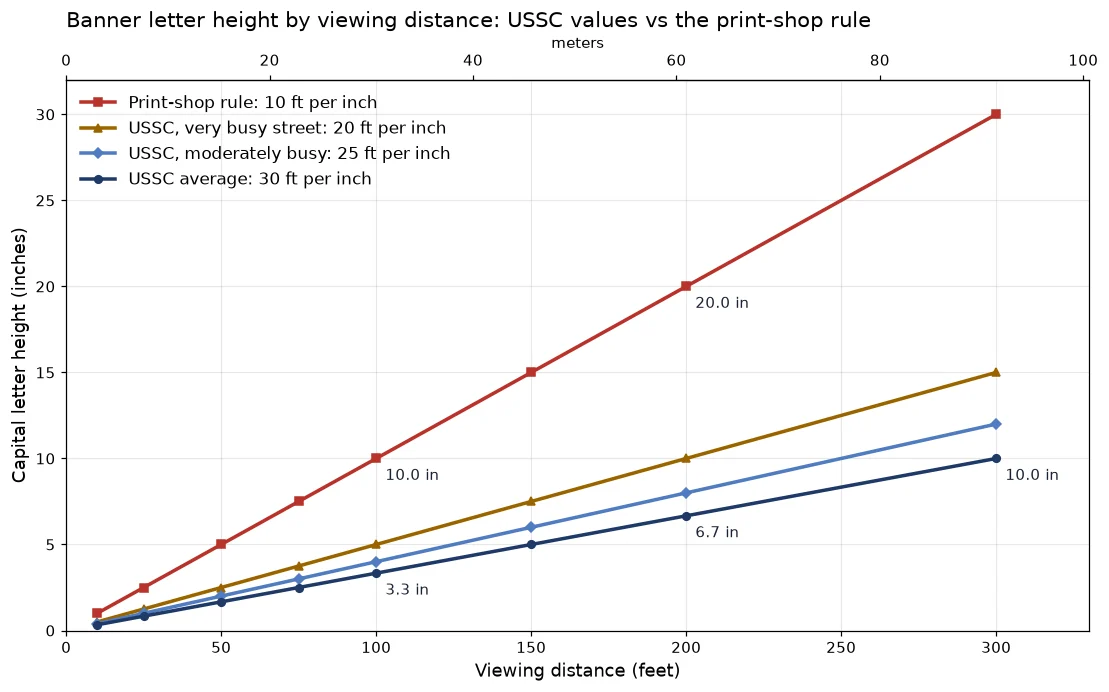
Banner sizing starts with the reader’s distance, and the two published rules for it differ by a factor of three. Print shops use a rule of thumb; Vistaprint puts it as “for every inch of text height, plan for about 10 feet of visibility”, so 6 in letters read at 60 ft. The United States Sign Council Guideline Standards for On-Premise Signs (2018) use a legibility index instead: feet of viewing distance per inch of capital letter height. Its average value is 30, measured with drivers on a test track, and the guideline warns that this “is an average only” and may fall short of what a specific sign needs. For busier streets it applies adjustment factors of 0.83 for moderately congested zones and 0.67 for highly congested ones, which bring the average to 25 and 20, and it asks for letters 15 percent taller when a message is set in all capitals.
Read the two rules as a range. The USSC value describes reading under test-track conditions; the 10 ft rule leaves a wide margin for a glance, a cluttered background or a reader who is not looking for the banner. Dividing the distance by each value gives the capital letter height.
| Viewing distance | USSC average (÷ 30) | Moderately busy street (÷ 25) | Very busy street (÷ 20) | Print-shop rule (÷ 10) |
|---|---|---|---|---|
| 25 ft (7.6 m) | 0.8 in (2.1 cm) | 1.0 in (2.5 cm) | 1.3 in (3.2 cm) | 2.5 in (6.4 cm) |
| 50 ft (15.2 m) | 1.7 in (4.2 cm) | 2.0 in (5.1 cm) | 2.5 in (6.4 cm) | 5.0 in (12.7 cm) |
| 100 ft (30.5 m) | 3.3 in (8.5 cm) | 4.0 in (10.2 cm) | 5.0 in (12.7 cm) | 10.0 in (25.4 cm) |
| 200 ft (61.0 m) | 6.7 in (16.9 cm) | 8.0 in (20.3 cm) | 10.0 in (25.4 cm) | 20.0 in (50.8 cm) |
| 300 ft (91.4 m) | 10.0 in (25.4 cm) | 12.0 in (30.5 cm) | 15.0 in (38.1 cm) | 30.0 in (76.2 cm) |
Letter height is the viewing distance divided by the figure in each column header: the USSC guideline values and the print-shop rule of thumb.
The USSC figures come from drivers, so for people on foot at a trade show or market they are an extrapolation; there the distance is usually short and the print-shop rule costs little. On a road, the USSC adjusted values are the better guide. In all capitals, add 15 percent to either column.
How do you get from letter height to banner size?
A banner size follows from the letter height and the length of the message. The USSC guideline gives the method: square the letter height to get the area one letter and its spacing take up, multiply by the number of letters to get the copy area, and leave at least 60 percent of the panel as open space, which means the panel is 2.5 times the copy area. The matrix applies that method at the USSC average and picks the smallest size from the chart above that is large enough.
| Viewing distance (USSC average) | 12 letters | 20 letters | 30 letters |
|---|---|---|---|
| 100 ft (3.3 in letters) | 2.3 sq ft → 2 × 3 ft | 3.9 sq ft → 2 × 3 ft | 5.8 sq ft → 2 × 3 ft |
| 200 ft (6.7 in letters) | 9.3 sq ft → 2 × 6 ft | 15.4 sq ft → 2 × 8 ft | 23.1 sq ft → 4 × 6 ft |
| 300 ft (10 in letters) | 20.8 sq ft → 4 × 6 ft | 34.7 sq ft → 5 × 8 ft | 52.1 sq ft → 6 × 10 ft |
Calculated with the USSC method: copy area is the number of letters times the letter height squared, and the panel is 2.5 times the copy area, rounded up to a size in the chart.
Then check two things. First, the lines have to fit: a line of letters is roughly as wide as the number of letters times the letter height, so a 20-letter message in 10 in letters goes on two or three lines on a 5 × 8 ft banner, not one. Second, the rule you choose changes the size a great deal: under the print-shop rule the letters are three times taller, so the area is nine times larger, and the same 20 letters at 100 ft need 34.7 sq ft, a 5 × 8 ft banner instead of 2 × 3 ft. A logo or picture adds its own area on top of the copy area.
How much does each banner size weigh?
A banner’s weight is its area multiplied by the material weight, so a 3 × 6 ft banner weighs about 0.13–0.40 kg in our materials.
Banner weight matters for carrying, for the shipping weight of an order and for the load on a frame or a stand. Outdoors, the fixings are chosen for the wind load on the banner rather than for its own weight. Weight is the area multiplied by the material weight. The first five columns are the materials on our custom banners page, with their listed weights in grams per square meter; the last two are the 13 oz and 18 oz vinyl that US printers such as 4over4 list, added for comparison. All figures cover the printed material only, before hems, grommets and any pole pockets.
| Size | 100D polyester (70–80 g/m²) | 110 g knitted (110–115 g/m²) | 300D polyester (140 g/m²) | Mesh (125 g/m²) | PVC (240 g/m²) | US 13 oz vinyl (441 g/m²) | US 18 oz vinyl (610 g/m²) |
|---|---|---|---|---|---|---|---|
| 2 × 4 ft | 0.06 kg | 0.08 kg | 0.10 kg | 0.09 kg | 0.18 kg | 0.33 kg | 0.45 kg |
| 3 × 6 ft | 0.13 kg | 0.19 kg | 0.23 kg | 0.21 kg | 0.40 kg | 0.74 kg | 1.02 kg |
| 4 × 8 ft | 0.22 kg | 0.33 kg | 0.42 kg | 0.37 kg | 0.71 kg | 1.31 kg | 1.81 kg |
| 5 × 10 ft | 0.35 kg | 0.52 kg | 0.65 kg | 0.58 kg | 1.11 kg | 2.05 kg | 2.83 kg |
| 100 × 400 cm | 0.30 kg | 0.45 kg | 0.56 kg | 0.50 kg | 0.96 kg | 1.76 kg | 2.44 kg |
Weight is the banner area times the material weight listed on our custom banners page; US vinyl weights converted from oz/yd².
The 100D column uses the 75 g/m² midpoint of the listed range and the knitted column uses 112.5 g/m². US printers quote vinyl in ounces per square yard; one ounce per square yard is 33.9 g/m², so 13 oz is about 441 g/m², 18 oz is about 610 g/m², and the 240 g/m² PVC on our page is about 7.1 oz, a lighter grade than either. When two quotes use different units, convert both before comparing them.
Which banner material suits which size: fabric, mesh or PVC?
Banner material follows the place the banner hangs. Fabric suits indoor and close-range display, PVC suits outdoor display where a solid, wipeable surface matters, and mesh suits fences and scaffolding where an open, see-through weave is wanted.
| Material | Weight | Where it fits | What to check |
|---|---|---|---|
| 100D polyester | 70–80 g/m² (about 2.2 oz/yd²) | Light indoor banners, short events | Light fabric moves in drafts; fix all four corners |
| 110 g knitted polyester | 110–115 g/m² (about 3.3 oz/yd²) | Backdrops, trade show walls, booth fronts | Knitted fabric drapes; ask how the edges are finished |
| 300D polyester | 140 g/m² (about 4.1 oz/yd²) | Fabric banners that need more body | Heavier fabric, still foldable for shipping |
| Mesh | 125 g/m² (about 3.7 oz/yd²) | Fences and scaffolding where a see-through weave is wanted | Ask how open the weave is; the print is less dense than on solid PVC |
| PVC | 240 g/m² (about 7.1 oz/yd²) | Shop frontages, construction hoardings, sports grounds | A solid surface takes the full wind load |
Material weights as listed on our custom banners page.
Wind matters most at the large end of the chart, and neither vent holes nor an open weave removes most of the load. In wind tunnel tests by engineers at the University of Queensland and Queensland University of Technology, reported in The Conversation in 2016, vents reduced the wind load, but “the reduction in load is relatively small until porosity becomes large”, across vent areas from zero to about 20 percent, and at low wind speeds the vents could even raise the load by up to 5 percent. The same study found that banners with vents took lower loads than uniformly perforated plates, which it describes as behaving like porous mesh fabrics, so mesh should not be expected to do better than a vented banner. For a large banner on an exposed fence, the fixings and the fence carry the load whichever material you choose; size the banner to what the fence can take, and choose mesh for its look and its open weave rather than as a wind solution.
Not sure which size will read from where your banner hangs? Tell us the viewing distance, the message and where the banner will hang. We reply with the size and material we would use, and the sample time.
How do you order a custom banner size?
When you order a custom banner from a factory, write the size so that nobody has to guess. Banners can be made to any size, so the size you send is the size that gets printed. Put these in the request:
- The finished size in both units, for example “3 × 6 ft (91.4 × 182.9 cm) finished”, and whether that size includes the hems.
- Portrait or landscape, written as height × width.
- The material from the table above, or the place the banner will hang so the factory can suggest one.
- Printing method: our banners are printed by digital printing, silk screen printing or heat transfer printing, confirmed by material, artwork and quantity.
- Finishing: grommets for fences, frames and walls are available; their spacing and any other finishing are confirmed in the quotation.
- Quantity per design. Our minimum for custom banners is 50 pieces.
- Artwork at the finished size, with the letter height checked against the viewing-distance table.
Bulk production of our custom banners takes 15–20 calendar days from artwork confirmation, not counting shipping, and a sample can be made for approval first. Banners are rolled or folded, packed one per polybag and shipped in export cartons. For a full event display, banners are often ordered with feather flags and pop-up tents. Flag sizes, which follow different conventions from banners, are in our flag size chart, and minimums for other products are in custom flag MOQ and lead times.
Frequently asked questions
How big is a 3×5 banner?
A 3×5 banner is 3 × 5 ft, which is 36 × 60 in or 91.4 × 152.4 cm, and covers 15 sq ft (1.39 m²). By the USSC average it carries a 20-letter message readable to about 197 ft; by the print-shop rule of 10 ft per inch, the same layout reads to about 66 ft.
How big is a 24×36 banner?
A 24×36 banner is measured in inches: 24 × 36 in, the same as 2 × 3 ft, or 61.0 × 91.4 cm. It is the smallest common size, used on counters, doors and easels where it is read from a few feet away.
What is the size of a 48×24 banner?
A 48×24 banner is 48 × 24 in, which is 4 × 2 ft or 121.9 × 61.0 cm. Written that way, the width comes first: it is a landscape 2 × 4 ft banner.
How big is a 36×72 banner?
A 36×72 banner is 36 × 72 in, the 3 × 6 ft banner, or 91.4 × 182.9 cm. In 240 g/m² PVC it weighs about 0.4 kg before hems and grommets; in 13 oz vinyl, about 0.74 kg.
What is the difference between vinyl and fabric banners?
Vinyl (PVC) banners have a solid plastic surface for outdoor use; fabric banners are woven or knitted polyester, lighter and foldable, and used mostly indoors and for backdrops. On our banners page the PVC is 240 g/m², about 7.1 oz, lighter than the 13 oz vinyl common at US printers, and the fabrics are 70–140 g/m².
How do I choose a banner size for a fence?
Measure the fence panel, then work from the distance and the message. A 20-letter message read from 200 ft needs about 15 sq ft by the USSC average, which is a 2 × 8 ft banner; by the print-shop rule, the same message needs a 5 × 8 ft banner at only 100 ft. Check that the fence and its fixings can take the banner in wind.
To get a size and material checked before you order, send the place, the viewing distance and your message through our quote form.
Data behind the tables: Vistaprint, 4over4 and UPrinting size guides for US size names and retractable widths; United States Sign Council Guideline Standards for On-Premise Signs (2018) for the legibility index, its adjustment factors and the sign-area method; our custom banners product page for materials, weights, uses, minimum order and lead time, as of 20 October 2026; 1 ft = 30.48 cm and 1 oz/yd² = 33.9 g/m². Charts and the to-scale drawing are illustrations made from these figures.