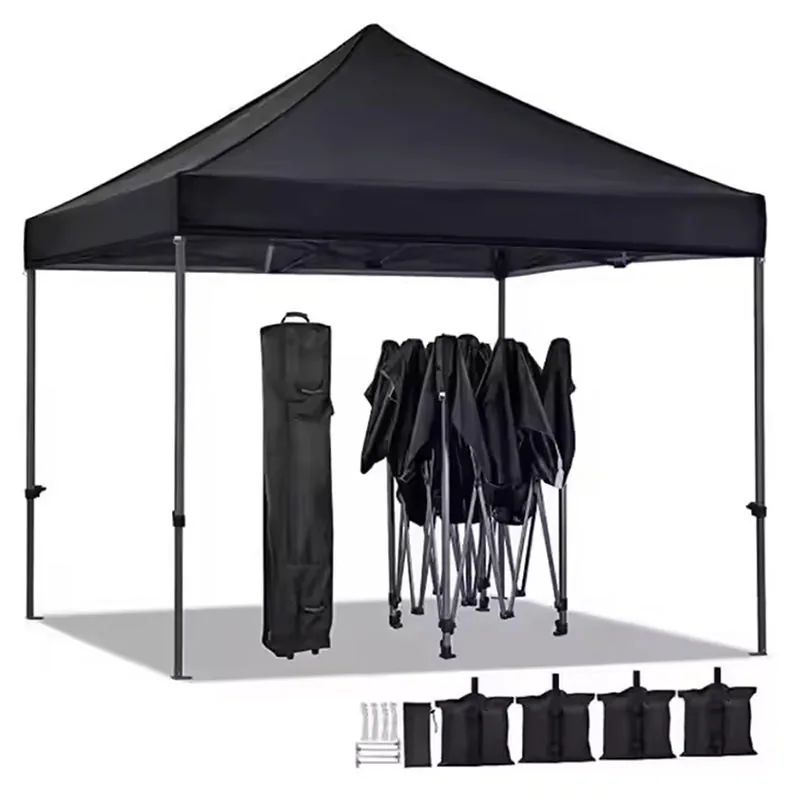
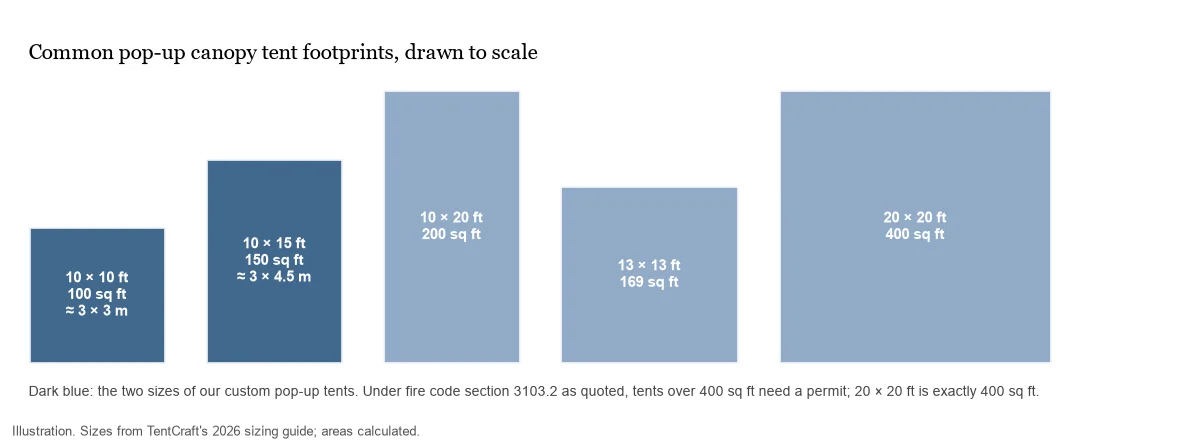
The standard pop-up canopy tent is 10 × 10 ft (100 sq ft, about 3 × 3 m); 10 × 15 and 10 × 20 ft are the common larger sizes.
- Hospitality and seating: 20 × 20 ft and up
- Occupant load: fire codes count at most 20 people standing in 100 sq ft
- Leg weights: published market rules ask for 10 to 40 lb per leg
- Fire permit: under International Fire Code wording, tents over 400 sq ft, with an exception for small open-sided tents
- Local rules: can be stricter; some towns require a permit over 200 sq ft
This guide is for buyers ordering branded event tents: event companies, promotional product suppliers and brands planning booths for markets, festivals and trade shows. Sizes are given in feet, as US event spaces are sold, and in meters, as metric quotes give them (1 ft = 0.3048 m).
What sizes do pop-up canopy tents come in?
Pop-up canopy tents are sized by the footprint of the frame, from about 5 × 5 ft to 20 × 40 ft. TentCraft, a US tent maker, lists sizes from 5 × 5 ft to 20 × 40 ft in its February 2026 sizing guide. The chart gives each size in meters, the most people the fire and building codes allow in it, and whether it passes the 400 sq ft permit trigger discussed below.
| Size (ft) | Area | Size in meters | Code occupant load: standing / chairs / tables and chairs | Over 400 sq ft? |
|---|---|---|---|---|
| 5 × 5 | 25 sq ft (2.3 m²) | 1.52 × 1.52 | 5 / 3 / 1 | No |
| 8 × 8 | 64 sq ft (5.9 m²) | 2.44 × 2.44 | 12 / 9 / 4 | No |
| 10 × 10 | 100 sq ft (9.3 m²) | 3.05 × 3.05 | 20 / 14 / 6 | No |
| 10 × 15 | 150 sq ft (13.9 m²) | 3.05 × 4.57 | 30 / 21 / 10 | No |
| 10 × 20 | 200 sq ft (18.6 m²) | 3.05 × 6.10 | 40 / 28 / 13 | No |
| 12 × 12 | 144 sq ft (13.4 m²) | 3.66 × 3.66 | 28 / 20 / 9 | No |
| 13 × 13 | 169 sq ft (15.7 m²) | 3.96 × 3.96 | 33 / 24 / 11 | No |
| 15 × 15 | 225 sq ft (20.9 m²) | 4.57 × 4.57 | 45 / 32 / 15 | No |
| 10 × 30 | 300 sq ft (27.9 m²) | 3.05 × 9.14 | 60 / 42 / 20 | No |
| 20 × 20 | 400 sq ft (37.2 m²) | 6.10 × 6.10 | 80 / 57 / 26 | No |
| 20 × 30 | 600 sq ft (55.7 m²) | 6.10 × 9.14 | 120 / 85 / 40 | Yes |
| 20 × 40 | 800 sq ft (74.3 m²) | 6.10 × 12.19 | 160 / 114 / 53 | Yes |
Occupant loads use the code’s 5, 7 and 15 sq ft per person for standing, chairs, and tables and chairs, rounded down.
The occupant loads use the code’s floor area per person, as in Table 1004.5 of Washington’s adopted code: 5 sq ft per person standing, 7 sq ft on chairs and 15 sq ft at tables and chairs, rounded down. They are ceilings for an empty tent, not comfortable numbers; TentCraft, for comparison, estimates 12–15 standing or 8–12 seated under a 10 × 10 ft tent, and tables, coolers and displays cut the count further. To size a tent for a group, multiply the guests by the figure for the layout. 70 guests standing need at least 350 sq ft, which a 20 × 20 ft tent covers. On chairs they need 490 sq ft, a 20 × 30 ft tent. At tables and chairs they need 1,050 sq ft, more than the largest size in the chart, so two tents or a larger frame tent. The chairs and tables layouts both take tents over 400 sq ft, the permit threshold discussed below, and a single tent of 1,050 sq ft is also over the 700 sq ft limit of the open-sides exception.
Is a 3 × 3 m tent the same as a 10 × 10 ft tent?
A tent quoted as 3 × 3 m is sold in the US as 10 × 10 ft, but the two are not identical: 3 m is 9.84 ft, so a 3 × 3 m frame covers 96.9 sq ft against 100 sq ft. In the other direction, a true 10 × 10 ft frame is 3.05 m on each side. The difference is small for the shade, and it works in the buyer’s favor where space is tight: a 3 × 3 m tent fits inside a 10 × 10 ft market pitch with 4.8 cm to spare across its width, 2.4 cm at each edge.
| Metric size | In feet | Area | Sold in the US as |
|---|---|---|---|
| 3 × 3 m | 9.84 × 9.84 ft | 9.0 m² (96.9 sq ft) | 10 × 10 ft |
| 3 × 4.5 m | 9.84 × 14.76 ft | 13.5 m² (145.3 sq ft) | 10 × 15 ft |
| 3 × 6 m | 9.84 × 19.69 ft | 18.0 m² (193.8 sq ft) | 10 × 20 ft |
Converted at 1 m = 3.2808 ft.
Our custom pop-up tents come in the first two sizes, 3 × 3 m (10 × 10 ft) and 3 × 4.5 m (10 × 15 ft). The canopy is 420D Oxford cloth with a PU/PVC coating, on a steel or aluminium folding frame with a white powder coating. When a show or market lists a pitch size in feet, compare it with the frame size in meters before ordering, and allow room for the weights at each leg.
How much weight does a canopy tent need per leg?
Published market rules ask for 10 to 40 lb (4.5 to 18 kg) on each leg, and an extension service advises 40 lb per leg for a 10 × 10 ft tent.
A pop-up canopy is light for its size, and its roof catches wind like a sail, so every leg needs weight or an anchor. There is no national rule in the US for how much; the figures that exist come from the markets and agencies that run outdoor events. Four published examples:
| Source | Rule or advice | Per leg in kg |
|---|---|---|
| Dale City Farmers Market, Prince William County, Virginia | At least 10 lb per leg on every tent, canopy and umbrella, sitting on the ground, not hanging; vendors must work out the weight their own tent needs | 4.5 kg minimum |
| Rensselaer Farmers Market at Riverfront Park, New York (2026 rules) | No less than 20 lb on each canopy leg; 50 lb for an umbrella | 9.1 kg |
| Larimer County Farmers’ Market, Colorado (2026 season) | 40 lb per leg; tents without adequate weights may have to come down | 18.1 kg |
| Virginia Cooperative Extension (Virginia State University, 2019) | Aim for 40 lb per leg on a 10 × 10 ft tent | 18.1 kg |
Rules as published by each market or agency; kilograms converted at 1 lb = 0.4536 kg.
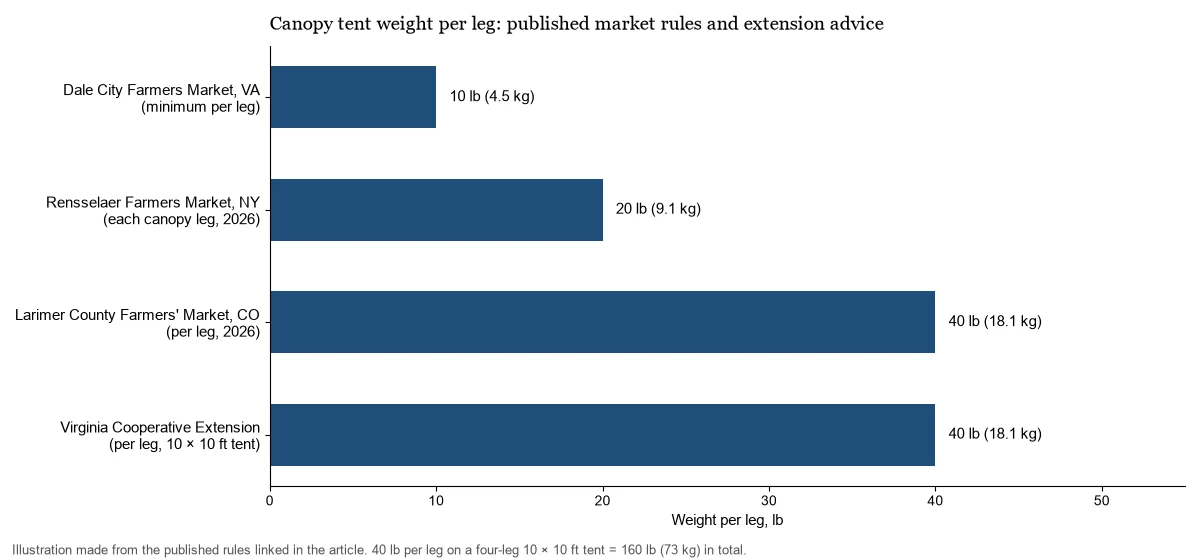
For a four-leg 10 × 10 ft tent, 40 lb per leg is 160 lb (73 kg) in total. The markets also say how the weight is attached. Rensselaer wants weights on the ground, tethered with solid, clearly visible lines rather than bungee cords. Dale City also wants them on the ground rather than hanging from the frame, with soft edges and no tripping hazard, and it rules out tying a canopy to tables or coolers. Its own examples differ from Rensselaer’s rule in one detail: cans, capped PVC pipe, canvas bags or buckets filled with cement, tied to each corner with a rope or bungee. Dale City also accepts tying the back of a canopy to a vehicle as long as the front legs are weighted. A larger tent has more roof to catch the wind, so it needs more weight in total. Before an event, read the organizer’s rules; they set the number that applies on the day.
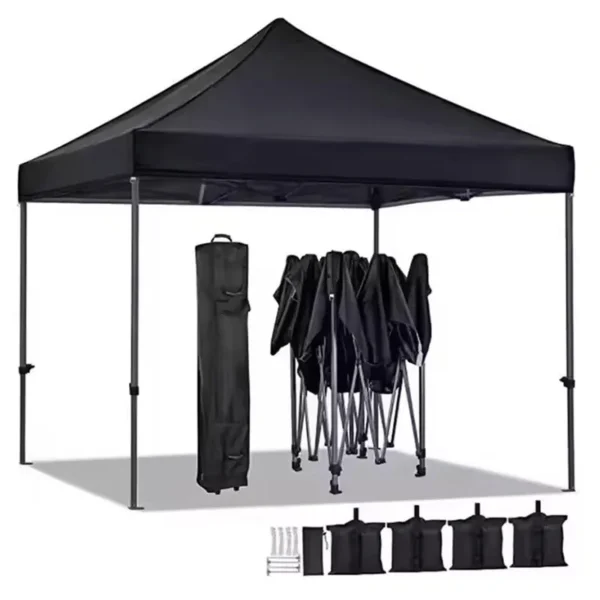
Weight bags filled on site save shipping heavy weights. Water weighs 1 kg per liter, so an 18.1 kg (40 lb) weight needs 18.1 liters of water, about 4.8 US gallons. Dry sand is denser: the Engineering ToolBox density table gives 1,555 kg/m³, so the same weight needs about 11.7 liters of dry sand. Our tents can be ordered with sand bags, ground weights, or ropes and nails; the accessories for each order are confirmed with the quotation.
When does a canopy tent need a fire permit?
Under International Fire Code wording, a tent over 400 sq ft needs a fire permit unless it meets the exception for small open-sided tents. Size also decides whether a tent needs a permit. Many US states and cities base their fire codes on the International Fire Code, with local changes. In the California Fire Code text, which follows the IFC, reproduced in the City of Napa’s temporary tent permit information, section 3103.2 says that tents over 400 sq ft (37 m²) need a permit and approval from the fire code official. Tents open on all sides are exempt when each tent is no larger than 700 sq ft (65 m²), tents placed side by side without a 12 ft fire break total no more than 700 sq ft, and there is at least 12 ft of clearance to structures and other tents. Local rules can go lower. Oxford, Ohio, for example, requires a zoning permit for any single tent over 200 sq ft, open-sided or not, so a 15 × 15 ft or 20 × 20 ft tent needs one there, and a tent over 400 sq ft with any side enclosed also falls under the Ohio Fire Code.
Applied to the sizes above:
- A 10 × 10, 10 × 15 or 10 × 20 ft tent is under 400 sq ft and needs no permit under this section on its own.
- A 20 × 20 ft tent is exactly 400 sq ft, which is not “in excess of” 400, so it is also below the threshold.
- Larger tents pass the threshold. Open on all sides and at least 12 ft from structures and other tents, they stay exempt up to 700 sq ft, and tents set side by side without a 12 ft fire break count together toward that 700 sq ft. Add walls, and the open-sides exception no longer applies. Ask the fire code official how tents joined together are counted against the 400 sq ft trigger.
Local amendments change these numbers in some places, so check the threshold with the fire code official where the event is held. Where a permit is needed, the same code asks for documentation that the tent fabric, sidewalls and drops meet the flame propagation performance of NFPA 701, Test Method 2. Our pop-up tent product page makes no NFPA 701 claim, so if your event needs a permit, confirm with the fire code official what documentation is required before you order. The same chapter also requires every tent to be installed to withstand the weather and not collapse, which is what the weights above are for.
Need branded tents for an event program? Send your logo and the tent sizes you need. We reply with the print areas for each size, and the sample time.
How do you order custom printed canopy tents?
For a branded tent, the size decides the print areas as well as the space. Our pop-up tents can be printed by digital printing on the roof and valance, which carry the main logo and are seen from all sides, and on a back wall and side walls, which can repeat the roof artwork or carry separate designs. Walls are optional, and leaving them off keeps a tent open on all sides, which matters under the permit rules above.
Put these in a quote request:
- The tent size, 3 × 3 m (10 × 10 ft) or 3 × 4.5 m (10 × 15 ft), and the pitch size at your events.
- The frame: steel or aluminium, both with a white powder coating; the frame material is confirmed with the quotation according to how the tent will be used.
- The print areas: roof and valance only, or with a back wall and side walls, and the artwork for each.
- The canopy color, confirmed together with the artwork.
- Accessories: sand bags, ground weights, ropes and nails, rain gutter, rolling flap, wheeled carry bag, sidewall carry bag or folding table.
- Quantities: our minimum order is 10 sets.
Bulk production takes 20–30 calendar days from artwork confirmation, not counting shipping, and a sample takes 5–7 calendar days. Each set is packed in a polybag, with five sets to an export carton. Tents can be combined with feather flags for an outdoor booth; our feather flag sizes guide covers the flag heights, and the MOQ and lead time guide covers minimums across our other products.
Frequently asked questions
What is the standard size of a pop-up canopy tent?
10 × 10 ft, or 3 × 3 m where tents are quoted in meters. It covers 100 sq ft (9.3 m²) and fits a 10 × 10 ft market pitch.
How many people fit under a 10 × 10 canopy?
The building code counts up to 20 people standing, 14 on chairs or 6 at tables and chairs in 100 sq ft. In practice, with one or two tables and a display, plan for far fewer.
What size tent do I need for 70 guests?
At the code’s floor area per person, 70 guests need at least 350 sq ft standing, which a 20 × 20 ft tent covers; 490 sq ft on chairs, a 20 × 30 ft tent; and 1,050 sq ft at tables and chairs, more than a 20 × 40 ft tent. The seated layouts need tents over 400 sq ft, so check the permit rules.
How much weight do I need per leg for a 10 × 10 canopy?
The rules quoted above range from at least 10 lb to 40 lb per leg, and Virginia Cooperative Extension advises 40 lb (18 kg) per leg for a 10 × 10 ft tent, 160 lb (73 kg) in all. The event organizer’s rule is the one that applies.
What can I use to weigh down a canopy?
Weights that sit on the ground and are tied to the frame: sand bags, water-filled weights or purpose-made ground weights. Market rules ask for weights with soft edges, tethered with clearly visible lines, and not tied to tables or coolers. On grass, ropes and stakes can be used where the organizer allows them.
Does a 20 × 20 canopy tent need a permit?
Often not a fire permit: under the IFC wording quoted above, the permit trigger is over 400 sq ft, and a 20 × 20 ft tent is exactly 400 sq ft. But local rules can be stricter: Oxford, Ohio, requires a zoning permit for any single tent over 200 sq ft, and the event organizer or city can still ask for an event permit or anchoring details. Check with the fire code official where the event is held.
Is a 3 × 3 m tent the same as a 10 × 10 ft tent?
Nearly. 3 m is 9.84 ft, so a 3 × 3 m tent covers 96.9 sq ft, about 3% less than 100 sq ft, and fits inside a 10 × 10 ft pitch.
To order printed tents for your events, send the size, frame, print areas, accessories and quantity through our quote form.
Sources: TentCraft’s canopy tent sizing guide (February 2026) for the size range; the vendor rules of Dale City Farmers Market (Prince William County, Virginia), Rensselaer Farmers Market at Riverfront Park (2026) and Larimer County Farmers’ Market (2026), and Virginia Cooperative Extension, for weights per leg; the California Fire Code text reproduced by the City of Napa and the City of Oxford, Ohio, tent permit table for permit thresholds and fabric documentation; Washington’s adopted code (WAC 51-54A-1004, Table 1004.5) for floor area per person; Engineering ToolBox for sand density; our custom pop-up tents product page, as of 20 October 2026. Metric figures are converted at 1 ft = 0.3048 m and 1 lb = 0.4536 kg. Charts are illustrations made from these figures.