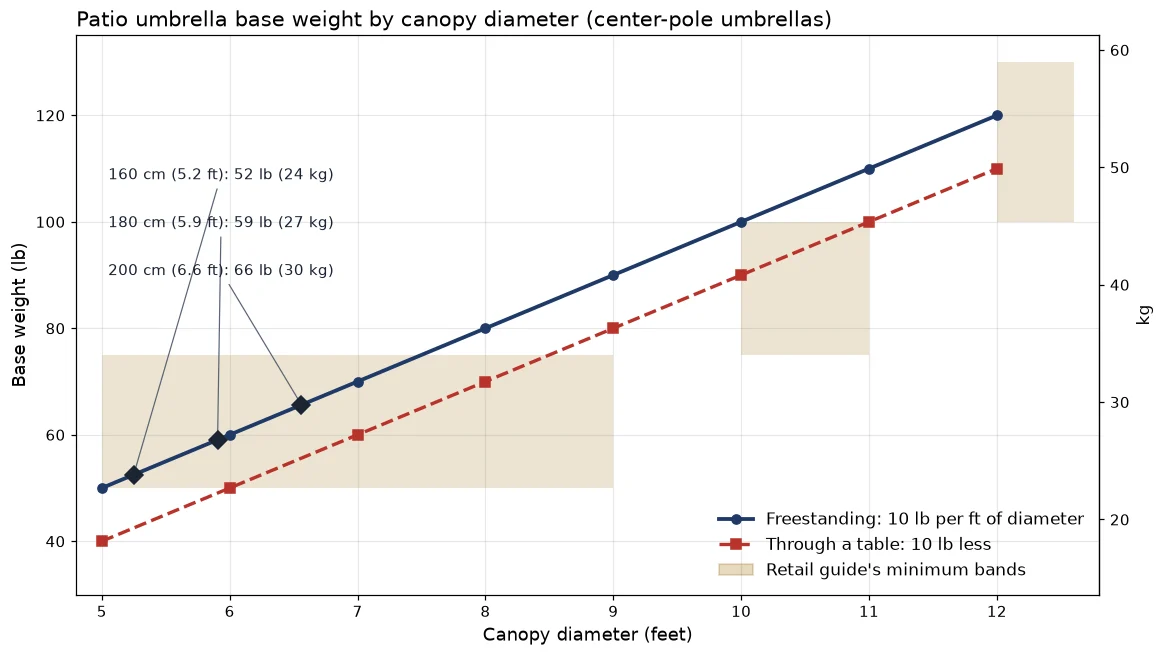
Umbrella retailers’ rule of thumb is about 10 lb of base per foot of canopy diameter: about 90 lb (41 kg) for a freestanding 9 ft umbrella.
- Through a table: about 10 lb less, according to one retail guide
- Cantilever umbrellas: 180–200 lb for canopies up to 10 ft
- Add weight for: wind, tilt and height above ground
- Standards: the two ASTM umbrella standards set tests, not patio base weights

Weights below are given in pounds and kilograms, and canopy sizes in feet and centimeters, because umbrellas sold in the US are sized in feet while most factories quote them in centimeters (1 ft = 30.48 cm; 1 lb = 0.4536 kg).
How heavy should an umbrella base be for each canopy size?
A freestanding umbrella needs roughly 10 lb of base per foot of canopy diameter, and about 10 lb less when it passes through a table.
Patio Heat and Shade, a US umbrella retailer, gives minimum base weights in bands: 50–75 lb for market umbrellas up to 9 ft, 75–100 lb for 10–11 ft and more than 100 lb from 12 ft. It calls 10 lb per foot of diameter “a good conservative estimate”, and adds weight for conditions: 10–20 lb in a windy area, 10 lb for a freestanding umbrella rather than one in a table, 10 lb if the canopy is often tilted and 20 lb at a high elevation. The freestanding and through-table columns below are our own application of that per-foot estimate and its 10 lb allowance, converted to kilograms.
| Canopy diameter | In cm | Freestanding (10 lb per ft) | Through a table (10 lb less) | Guide’s minimum band |
|---|---|---|---|---|
| 6 ft | 183 cm | 60 lb (27.2 kg) | 50 lb (22.7 kg) | 50–75 lb |
| 7 ft | 213 cm | 70 lb (31.8 kg) | 60 lb (27.2 kg) | 50–75 lb |
| 7.5 ft | 229 cm | 75 lb (34.0 kg) | 65 lb (29.5 kg) | 50–75 lb |
| 8 ft | 244 cm | 80 lb (36.3 kg) | 70 lb (31.8 kg) | 50–75 lb |
| 9 ft | 274 cm | 90 lb (40.8 kg) | 80 lb (36.3 kg) | 50–75 lb |
| 10 ft | 305 cm | 100 lb (45.4 kg) | 90 lb (40.8 kg) | 75–100 lb |
| 11 ft | 335 cm | 110 lb (49.9 kg) | 100 lb (45.4 kg) | 75–100 lb |
| 12 ft | 366 cm | 120 lb (54.4 kg) | 110 lb (49.9 kg) | more than 100 lb |
Per-foot figures and minimum bands from Patio Heat and Shade’s base weight guide; 1 lb = 0.4536 kg.
The figures diverge most at 8–9 ft, where the minimum band tops out at 75 lb and the per-foot rule gives 80–90 lb: the band is the guide’s minimum, and the per-foot rule is the conservative figure it recommends. Where the umbrella stands in wind, on a roof terrace or with its canopy tilted, start from the per-foot column and add the guide’s allowances. For a cantilever umbrella, whose pole stands to one side of the canopy, the guide’s minimum is 180–200 lb up to 10 ft and 400 lb or more above that, before any allowance.
How much water or sand does an umbrella base need?
A fillable umbrella base weighs what is inside it, so its capacity in liters decides the most it can weigh. Water weighs 1 kg per liter. Sand is heavier for the same volume: the Engineering ToolBox density table gives 1,555 kg/m³ for dry sand and 1,905 kg/m³ for wet sand, which is 1.56 and 1.91 kg per liter. The table shows the fill each target weight needs, not counting the empty shell.
| Target weight | Water | Dry sand | Wet sand |
|---|---|---|---|
| 50 lb (22.7 kg) | 22.7 L (6.0 US gal) | 14.6 L | 11.9 L |
| 75 lb (34.0 kg) | 34.0 L (9.0 US gal) | 21.9 L | 17.9 L |
| 90 lb (40.8 kg) | 40.8 L (10.8 US gal) | 26.3 L | 21.4 L |
| 100 lb (45.4 kg) | 45.4 L (12.0 US gal) | 29.2 L | 23.8 L |
Fill volume is the target weight divided by the fill density: water 1 kg per liter, dry sand 1.56 and wet sand 1.91 kg per liter (Engineering ToolBox).
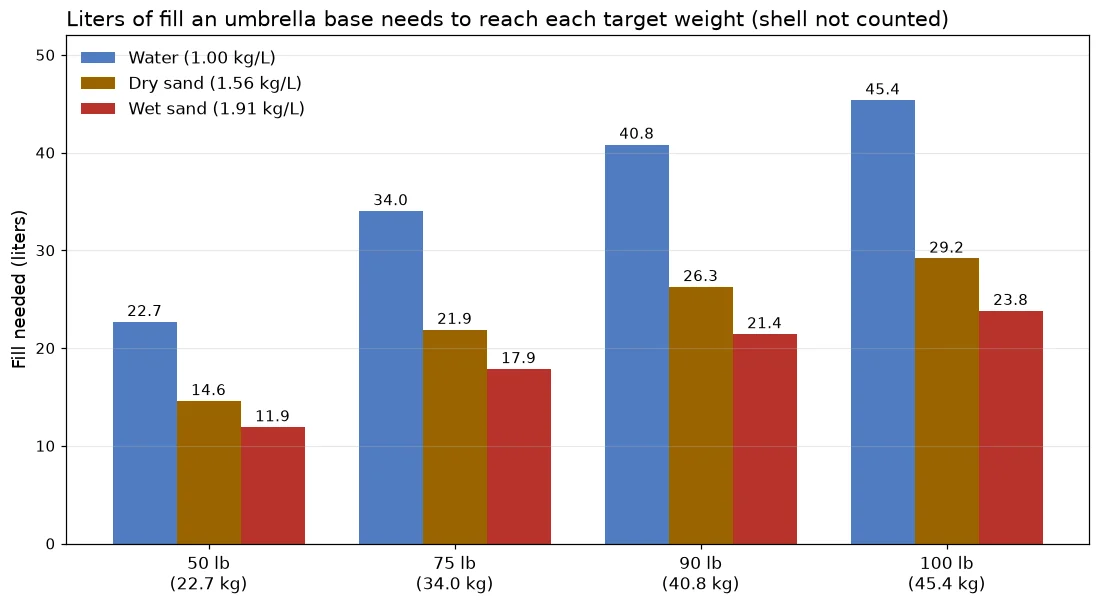
Read it the other way when you compare bases: a base that holds 25 L reaches about 25 kg (55 lb) with water and about 39 kg (86 lb) with dry sand. For a 9 ft freestanding umbrella that is the difference between falling short of the 90 lb rule and coming close to it. When a supplier quotes a fillable base, ask for its capacity in liters and its filled weight with water and with sand, and check the filled figure against the chart above rather than the base’s shipping weight.
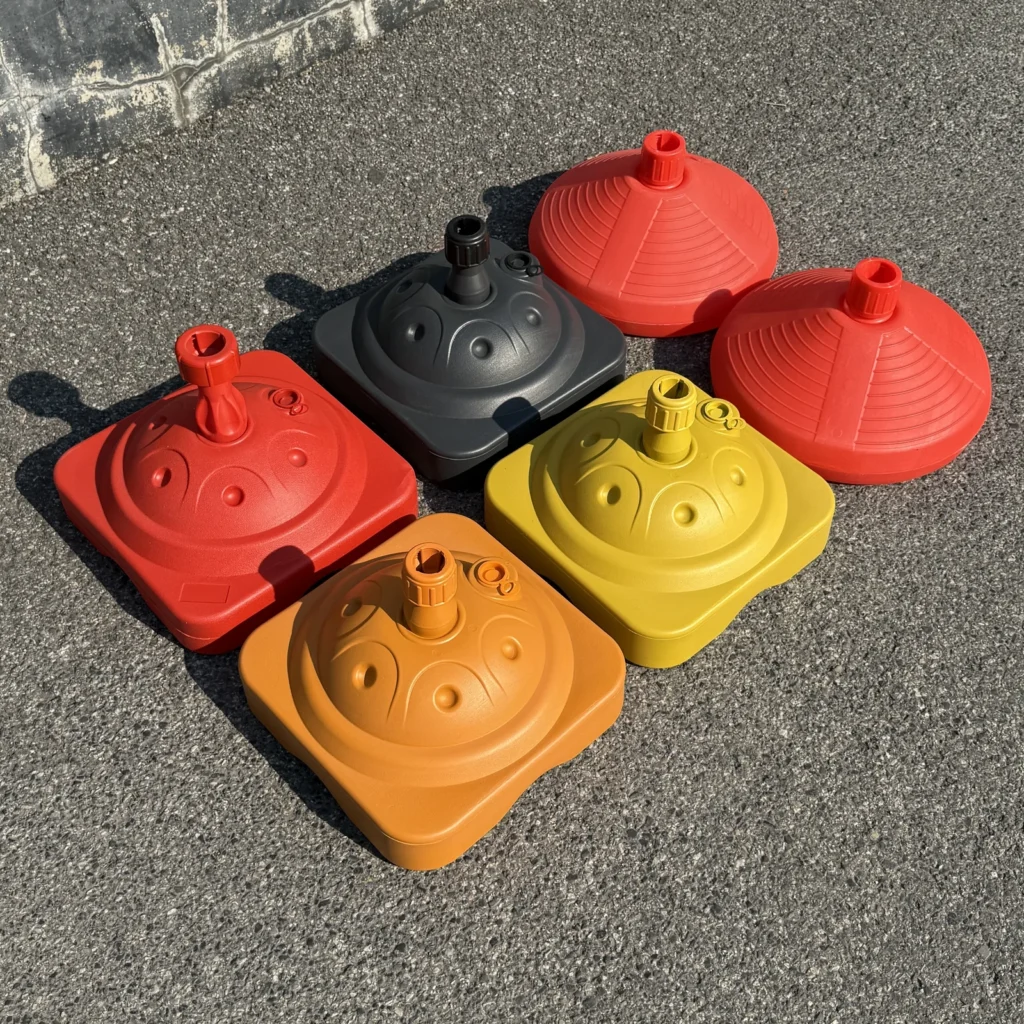
Our umbrella bases include plastic water-fill bases in red, black, orange or yellow; round or square water-fill bases for beach umbrellas, made in different liter capacities, with the size depending on the capacity; a 25 × 25 cm metal plate base with tightening knobs; a square granite base with a steel tube and handle; and cement brick bases for beach umbrellas. Sizes and capacities that are not listed on the umbrella bases page are confirmed at quotation, together with the tube diameter that has to match the umbrella pole.
What do umbrella safety standards say about base weight?
Two ASTM documents cover the umbrellas in this guide, and both set performance tests rather than a minimum base weight:
- ASTM F3681, the Standard Consumer Safety Specification for Beach Umbrellas and Anchor Devices, sets “performance requirements for beach umbrella/anchor systems to prevent the beach umbrella/anchor system from detaching from the sand”. The US Consumer Product Safety Commission’s 2024 safety alert describes the 2024 edition, ASTM F3681-24, as a voluntary standard under which compliant umbrella and anchor systems “must provide a resisting force of at least 75 pounds, or must remain secure in wind speeds of up to 30 mph, when a compliant anchor is installed in the sand”, and the anchor label states the largest canopy area it suits. The 2025 revision requires the entire pole to be tilted 20 degrees in the pull test.
- ASTM F3512, the Standard Test Method for Evaluating Wind Safety and Durability of Market Umbrellas, is a wind test for market umbrellas, the center-pole type that the base weight guide above also calls market umbrellas. It is a test method, and it gives no base weight.
Behind the beach standard are injury figures: a 2026 fact brief cites a 2019 Consumer Product Safety Commission flyer estimating 2,800 beach umbrella injuries treated in US emergency rooms from 2010 to 2018, about 311 a year. In practice, umbrellas standing in sand should be specified with an anchor labeled to ASTM F3681, while a patio umbrella base is chosen by weight, and the weight figures come from retailers’ rules of thumb rather than from a standard. Our beach umbrellas can be ordered with round or square water-fill bases or a cement brick base; these are weighted bases, not anchors tested to ASTM F3681, and we make no F3681 claim for them.
Neither test translates into a patio base weight: the 75 lb figure is a pull test for an anchor in sand, rated for a stated canopy size. A weighted patio base works differently. Its weight resists lift, and its weight and width together resist tipping, which is why the retail guide quoted above prefers the wider of two bases of similar weight.
How do patio umbrella sizes convert between centimeters and feet?
Patio umbrella sizes are quoted as the canopy diameter, and one foot is 30.48 cm. US retailers list them in feet, commonly from about 6 ft to 11 ft and more, while metric quotes, including ours, give centimeters, so the first step in comparing a factory quote with a US price list is the conversion. Our patio umbrellas come in three standard canopy diameters, with custom diameters on request. They sit at or below the small end of common US sizes (6 ft is about 183 cm), and the per-foot rule scales down with them:
| Canopy diameter | In feet | Base by the 10 lb per ft rule, freestanding | Through a table |
|---|---|---|---|
| 160 cm | 5.2 ft | 52 lb (23.8 kg) | 42 lb (19.3 kg) |
| 180 cm | 5.9 ft | 59 lb (26.8 kg) | 49 lb (22.3 kg) |
| 200 cm | 6.6 ft | 66 lb (29.8 kg) | 56 lb (25.2 kg) |
| 270 cm | 8.9 ft | 89 lb (40.2 kg) | 79 lb (35.6 kg) |
| 300 cm | 9.8 ft | 98 lb (44.6 kg) | 88 lb (40.1 kg) |
Calculated with the 10 lb per foot rule; 1 ft = 30.48 cm and 1 lb = 0.4536 kg.
The 270 and 300 cm rows are the metric sizes closest to the common 9 and 10 ft umbrellas, included for comparing quotes; they are not standard sizes on our page. The figures assume a center-pole umbrella, which is what our patio umbrellas are: an 8-panel 210D Oxford canopy on a 28 mm or 32 mm white-coated pole, supplied with the 25 × 25 cm metal plate base or a water base. Our advertising parasols, branded umbrellas used at markets and outside shops, are made to a custom canopy size and can be ordered with a metal cross stand or a plastic water-fill base, so for those the base is chosen after the canopy size is fixed.
Not sure which base suits your canopy? Tell us the canopy diameter, whether the umbrella stands alone or through a table, and the surface it stands on. We reply with the base options that fit the pole, and the sample time.
How should a venue order umbrellas and bases together?
An umbrella order for a café, a hotel or a branded program should fix the base at the same time as the canopy, because the base has to fit the pole and carry the canopy in the site’s wind. Put these in the request:
- The canopy diameter in centimeters and feet, and whether the umbrella stands alone or passes through a table.
- The site: ground-level terrace, rooftop, beach or roadside, and how exposed it is to wind.
- The base type, and for a fillable base its capacity in liters and its filled weight with water and with sand.
- The pole diameter, so the base tube can be matched; on our patio umbrellas it is 28 mm or 32 mm.
- Canopy fabric, colors and artwork: our patio umbrellas are printed by heat transfer or digital printing on 210D Oxford.
- Quantities: our minimum is 10 pieces for patio umbrellas and advertising parasols, and 20 pieces for bases ordered on their own.
Our patio umbrellas and parasols take 20–30 calendar days from artwork confirmation and our bases 20–25 calendar days, not counting shipping, and samples take 5–7 calendar days. Patio umbrellas are packed in a carry bag and carton. Our beach umbrellas start at 50 pieces and can be ordered with water-fill or cement brick bases; for use in sand, see the note on ASTM F3681 anchors above. For minimums across our other products, see custom flag MOQ and lead times.
Frequently asked questions
How heavy should a base be for an 11 foot umbrella?
About 110 lb (50 kg) if the umbrella stands alone, by the 10 lb per foot rule, and about 100 lb (45 kg) if it passes through a table. The retail guide’s minimum band for 10–11 ft umbrellas is 75–100 lb, before allowances for wind, tilt or height.
Is a 50 lb umbrella base heavy enough?
For a small umbrella, yes. By the per-foot rule, 50 lb (22.7 kg) suits a 5 ft umbrella standing alone or a 6 ft umbrella through a table. It is the bottom of the guide’s 50–75 lb minimum band for umbrellas up to 9 ft, while the per-foot rule asks about 80 lb for a 9 ft umbrella even through a table.
Is sand or water heavier for an umbrella base?
Sand. Dry sand weighs about 1.56 kg per liter and wet sand about 1.91 kg, against 1 kg for water, so the same fillable base is about half as heavy again when filled with dry sand.
How heavy should an umbrella base be in kg?
The 10 lb per foot rule works out to about 15 kg per meter of canopy diameter for a freestanding umbrella: about 30 kg for a 2 m umbrella and 45 kg for a 3 m umbrella. Through a table, take about 4.5 kg off.
How heavy should a cantilever umbrella base be?
Much heavier than a center-pole base: the retail guide’s minimum is 180–200 lb (82–91 kg) for a cantilever umbrella up to 10 ft and 400 lb (181 kg) or more above that, because the canopy hangs to one side of the pole.
Does a beach umbrella in sand need a base or an anchor?
In sand, look for an anchor labeled “MEETS ASTM F3681 FOR WIND SPEEDS UP TO 30 MPH”. The CPSC’s alert describes the voluntary standard as requiring at least 75 lb of resisting force, or staying secure in 30 mph wind, with the anchor installed in the sand, for the canopy area stated on the label. Weighted bases such as ours are not F3681 anchors.
How do I stop a patio umbrella from blowing over?
Use a base at or above the per-foot weight for its size. In wind, keep the canopy upright: the retail guide warns that more than about 15 degrees of tilt turns the canopy into a sail, and advises not using the tilt at all in windy conditions. Passing the pole through a table steadies it, but the same guide warns that strong wind can break a glass table at the pole hole. When the umbrella becomes unstable in wind, close it; the CPSC gives the same advice for beach umbrellas.
How can I add weight to an umbrella base?
Set something compact and heavy on the base. The retail guide suggests an add-on weight made for the base, or sandbags: two bags holding 50 lb of sand each, it says, should help considerably. It also suggests bolting the base to the deck or ground, while noting that a mounted umbrella can still be damaged by wind. A fillable base gains about half its weight again when it is filled with dry sand instead of water (see the fill table above).
To match bases to an umbrella order, send the canopy diameter, the site and whether the umbrellas stand alone through our quote form, and ask for each base’s filled weight.
Data behind the tables: Patio Heat and Shade’s umbrella base weight guide for the minimum bands, allowances and the 10 lb per foot rule; ASTM F3681 and F3512 for the standards; the CPSC safety alert (May 2024) and, for injury figures, Gigafact (2026); Engineering ToolBox for sand densities; our patio umbrella, advertising parasol and umbrella base product pages, as of 20 October 2026; 1 ft = 30.48 cm and 1 lb = 0.4536 kg. Charts are illustrations made from these figures.